Updated: June 26, 2026. AI Pilot Daily may earn a commission when readers purchase through links on this page, at no additional cost to them. Our recommendations are based on practical use cases, product research, and fit for Amazon sellers.
Amazon sellers do not need another generic AI chatbot list. They need tools that help with product research, keyword discovery, listing optimization, advertising, competitor tracking, and content production. The best AI stack depends on where you are in the seller journey: finding a product, improving a listing, scaling ads, or building a brand beyond Amazon.
This guide focuses on AI and software tools that can help Amazon sellers make better decisions, save time, and improve execution. We prioritize tools with clear commercial use cases rather than novelty AI features.
For a wider tool-stack view, see our guide to the best Amazon seller tools.
Quick Picks
| Use Case | Best Pick | Why It Fits |
|---|---|---|
| All-in-one Amazon seller platform | Helium 10 | Strong coverage across product research, keyword research, listing optimization, operations, and ads. |
| Product and market research | Jungle Scout | Useful for sellers who want Amazon data, product discovery, and market intelligence. |
| Amazon PPC and profitability | SellerApp | Good fit for sellers focused on advertising, keyword tracking, and performance optimization. |
| SEO and off-Amazon traffic | Semrush | Useful for sellers building landing pages, content, brand search demand, and Google traffic. |
| AI content optimization | Surfer SEO | Helpful for sellers creating SEO content around product categories, buying guides, and comparison pages. |
| Product listing copy | ChatGPT or Claude | Best used as drafting assistants, not as a replacement for keyword and conversion data. |
How We Chose These Tools
We evaluated tools based on practical seller workflows, not just AI branding. The most important criteria were:
- Amazon-specific usefulness: Does the tool help with real seller tasks such as keyword research, listing optimization, product research, PPC, or operational decisions?
- Data depth: Does it provide marketplace, keyword, competitive, or campaign data that a general AI assistant cannot provide?
- Workflow fit: Can a seller use it regularly without creating another complicated process?
- Scaling potential: Does the tool become more useful as the seller grows?
- Commercial clarity: Is the tool worth paying for because it can affect revenue, conversion, ad efficiency, or content output?
1. Helium 10
Best for: Sellers who want one platform for Amazon product research, keyword research, listing optimization, advertising, and operations.
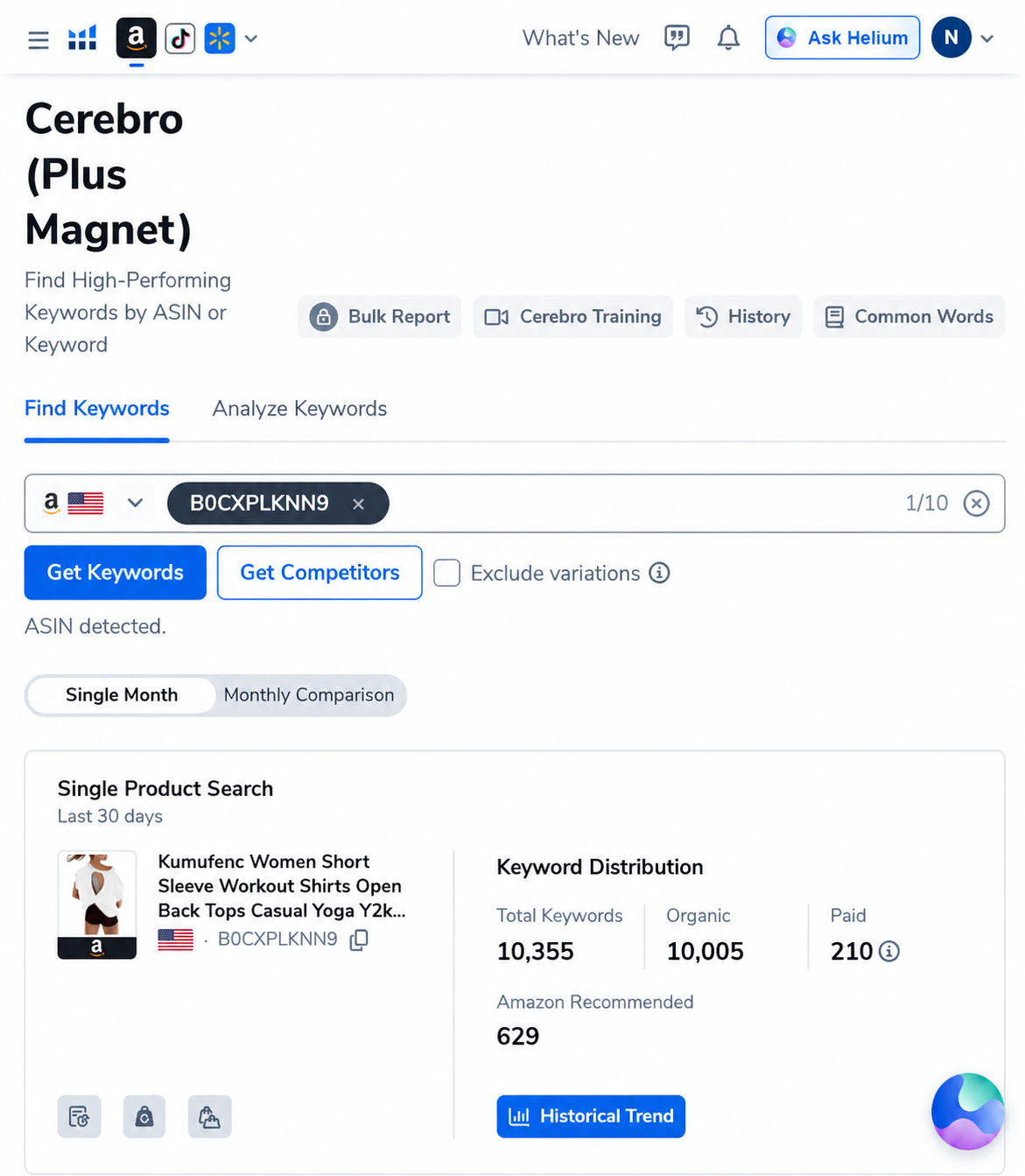
Helium 10 is the strongest first pick for many Amazon sellers because it covers a broad set of workflows. Our full Helium 10 review covers the buying decision in more detail. Its official site highlights product research, competitor analysis, keyword research, listing optimization, daily operations, inventory, alerts, analytics, and advertising automation. It also positions itself for Amazon, Walmart, and TikTok Shop sellers, which matters for brands that want to expand beyond one marketplace.
For AI-focused sellers, the most relevant pieces are listing creation and optimization, advertising recommendations, launch planning, and data-backed keyword research. A general AI writer can draft bullets, but Helium 10 is more useful when you need Amazon-specific keyword and competitor context.
Pros
- Broadest Amazon seller workflow coverage.
- Useful for both research and operations.
- Strong fit for sellers who want one main platform.
- Good foundation for product research, listing optimization, and PPC workflows.
Cons
- Can be more than a beginner needs on day one.
- Requires disciplined use; having many tools does not automatically improve a store.
- Pricing should be checked before subscribing because plans and limits can change.
Best fit: Serious Amazon sellers, private label sellers, and brands that want one platform instead of stitching together many small tools.
Also compare the two most searched Amazon seller platforms in our Helium 10 vs Jungle Scout guide.
2. Jungle Scout
Best for: Product research, market research, and seller intelligence.
Jungle Scout is one of the best-known Amazon seller platforms, especially for product research and market intelligence. It is a strong option for sellers who want to evaluate product opportunities, understand market demand, and track competitive signals before investing in inventory.
Jungle Scout is especially useful when your biggest problem is not copywriting but choosing the right product, market, or category. AI can help summarize ideas, but product research still needs marketplace data.
Pros
- Strong product research positioning.
- Good for sellers validating demand before launch.
- Useful for understanding categories and competitors.
Cons
- Not every seller needs both Jungle Scout and Helium 10 at the same time.
- Best value depends on whether product research is your main bottleneck.
Best fit: Sellers researching products, validating niches, or comparing Amazon opportunities before ordering inventory.
3. SellerApp
Best for: PPC, keyword tracking, and performance optimization.
SellerApp positions itself around Amazon PPC, keyword research, profit analytics, and seller optimization. It can fit sellers who are past the basic launch stage and need better visibility into campaigns, ranking, and profitability.
For sellers running ads, the real value is not AI copy generation. It is improving decisions around bids, keywords, campaign structure, and wasted spend. SellerApp belongs on the shortlist when advertising performance is the main problem.
Pros
- Good fit for advertising-focused sellers.
- Useful when PPC efficiency matters more than product discovery.
- Can support keyword and profitability decisions.
Cons
- May not be the first tool a brand-new seller needs.
- Sellers should compare it against their existing PPC workflow before committing.
Best fit: Sellers with active ad spend who want better Amazon PPC and performance decisions.
4. Semrush
Best for: Amazon sellers building off-Amazon SEO, content, and brand visibility.
Semrush is not an Amazon seller platform in the same way as Helium 10 or Jungle Scout. Its value is different: it helps sellers understand Google search demand, competitor traffic, content gaps, backlinks, paid search, and broader online visibility.
This matters because many Amazon sellers eventually need traffic sources outside Amazon. Product comparison pages, buying guides, niche blogs, Shopify stores, and brand landing pages can all benefit from SEO research. Semrush is also increasingly relevant as AI search visibility becomes part of the marketing conversation.
Pros
- Strong for keyword research, competitor research, and content planning.
- Useful beyond Amazon marketplace optimization.
- Good fit for brands building Google traffic and authority.
Cons
- Not designed specifically for Amazon listing optimization.
- May be too broad if you only sell through Amazon and do not plan to build owned traffic.
Best fit: Sellers who want to build a brand, content site, Shopify store, or off-Amazon traffic engine.
5. Surfer SEO
Best for: SEO content briefs and optimization for seller-owned websites.
Surfer SEO is useful when an Amazon seller is creating content around product categories, alternatives, buying guides, or niche education. It helps turn keyword ideas into more structured content plans and optimization workflows.
Surfer is not a replacement for Amazon keyword tools. It is better for Google-facing pages that support a brand, blog, or affiliate strategy. For example, a kitchen brand might use Amazon tools for listings and Surfer for articles like “best non-toxic cookware materials” or “ceramic vs stainless steel pans.”
Pros
- Useful for content briefs and on-page SEO optimization.
- Good companion to Semrush or other keyword tools.
- Fits brands investing in long-term organic traffic.
Cons
- Not an Amazon seller operations platform.
- Best used when you have a content strategy, not just one product listing.
Best fit: Sellers building SEO content, comparison pages, and authority websites around their products.
6. ChatGPT or Claude
Best for: Drafting, brainstorming, customer research summaries, and content variation.
General AI assistants are useful for Amazon sellers, but they should not be treated as standalone Amazon seller tools. They are best used after you already have marketplace data from tools like Helium 10, Jungle Scout, SellerApp, or Amazon Seller Central.
Good use cases include rewriting bullet points, generating image concept ideas, summarizing customer review themes, creating customer persona notes, and drafting email or ad copy variations. The seller still needs to verify claims, compliance, keyword fit, and product accuracy.
Pros
- Flexible and fast for drafting.
- Useful for brainstorming and content variations.
- Can speed up manual workflows when paired with real data.
Cons
- No built-in Amazon marketplace data.
- Can hallucinate features, claims, or compliance-sensitive wording.
- Outputs still need human review.
Best fit: Sellers who already have product, keyword, and customer data and need faster drafting or analysis.
Recommended Stack by Seller Stage
Beginner validating a product
- Primary: Jungle Scout or Helium 10
- Support: ChatGPT or Claude for idea organization and listing drafts
Private label seller preparing a launch
- Primary: Helium 10
- Support: ChatGPT or Claude for listing drafts, customer research, and launch content
Seller with active Amazon PPC
- Primary: SellerApp or Helium 10 Ads
- Support: Helium 10 or Jungle Scout for keyword and market data
Brand building off-Amazon traffic
- Primary: Semrush
- Support: Surfer SEO for content optimization and ChatGPT or Claude for drafting
What We Would Choose First
If we were starting with one paid Amazon seller platform, we would usually shortlist Helium 10 first because it covers the widest set of seller workflows. If product research is the only goal, Jungle Scout deserves a close comparison. If PPC is already the biggest pain point, SellerApp or Helium 10 Ads may be more relevant.
For sellers who want to build an actual brand and not depend only on Amazon search, Semrush and Surfer SEO become important. They help with content, organic search, and broader visibility outside the marketplace.
Final Recommendation
The best AI tool stack for Amazon sellers is not one tool. It is a layered system:
- Marketplace intelligence: Helium 10 or Jungle Scout
- Advertising and profitability: SellerApp or Helium 10 Ads
- Off-Amazon SEO: Semrush
- Content optimization: Surfer SEO
- Drafting and analysis: ChatGPT or Claude
For most serious sellers, the best first move is to choose one Amazon-native platform and then add AI drafting and SEO tools only when the workflow demands them. Tool stacking is useful only when each tool has a clear job.
FAQ
Do Amazon sellers need AI tools?
They do not need AI tools to start selling, but AI can speed up research, listing drafts, ad ideas, content planning, and customer review analysis. The key is combining AI with real marketplace data.
Is Helium 10 better than Jungle Scout?
Helium 10 is often stronger as an all-in-one platform. Jungle Scout is often considered for product and market research. The better choice depends on whether you need a broad operating platform or a focused product research workflow.
Can ChatGPT write Amazon listings?
Yes, but it should not write listings without product facts, keyword data, and human review. Sellers must verify claims, compliance, and accuracy before publishing.
What is the best AI SEO tool for Amazon sellers?
For off-Amazon SEO, Semrush is useful for keyword and competitor research, while Surfer SEO is useful for content briefs and optimization. Amazon listing SEO still requires Amazon-specific tools and Seller Central data.
Should sellers use paid tools before they have sales?
Beginners should be careful. A paid tool makes sense when it helps avoid a costly product mistake, improve a launch, or save meaningful time. If you are only experimenting, start with a clear research workflow before subscribing to multiple tools.