
AI Agents 2026: 40% of Enterprise Applications Will Use Them
The enterprise AI landscape is undergoing a fundamental transformation. My conversations with technology leaders across industries reveal a consistent theme: AI agents are moving from experimental projects to production deployments at an unprecedented pace.
The projection that 40% of enterprise applications will incorporate AI agent capabilities by 2026 isn’t merely optimistic speculation—it’s based on deployment pipelines I’m seeing firsthand. Organizations that spent 2024 and 2025 experimenting with AI agents are now moving those experiments into production.
Why 2026 Is the Breakout Year
Several factors have converged to make 2026 the year AI agents become enterprise-critical. The technology has matured, the use cases have proven themselves, and the organizational readiness has finally caught up with technical capability.
The foundation layer for this transformation includes improved model capabilities, better tool calling systems, and more reliable infrastructure for agent orchestration. When I look at the stack supporting AI agents today versus 18 months ago, the difference is dramatic.
Technology Maturation
AI models like GPT-5.5, Claude Opus 4.7, and Gemini 3.1 have achieved the capability thresholds necessary for reliable agentic workflows. These models demonstrate the reasoning, memory, and tool usage capabilities that make autonomous agent operation practical.
The tool calling infrastructure has stabilized significantly. Rather than brittle integrations prone to failure, modern tool calling provides reliable interfaces between agents and external systems. This reliability is essential for enterprise deployments where failures have real consequences.
Agent frameworks have matured from prototype quality to production-ready systems. The A2A (Agent-to-Agent) and MCP (Model Context Protocol) standards provide architectural patterns that enterprises can build against with confidence.
Proven Use Cases
Early AI agent deployments have generated compelling evidence of value. Organizations that piloted AI agents in 2024 and 2025 are reporting measurable improvements in efficiency, accuracy, and capability.
Customer service applications have shown particular success. AI agents handling customer inquiries with autonomous decision-making have demonstrated both cost reduction and quality improvement. The combination of faster response times and consistent quality has proven difficult to achieve with traditional approaches.
Software development workflows have benefited substantially from AI agent integration. Code generation, review, testing, and deployment tasks increasingly involve AI agents working alongside human developers. The productivity gains in development teams using AI agents have exceeded expectations.
Multi-Agent Systems: The New Paradigm
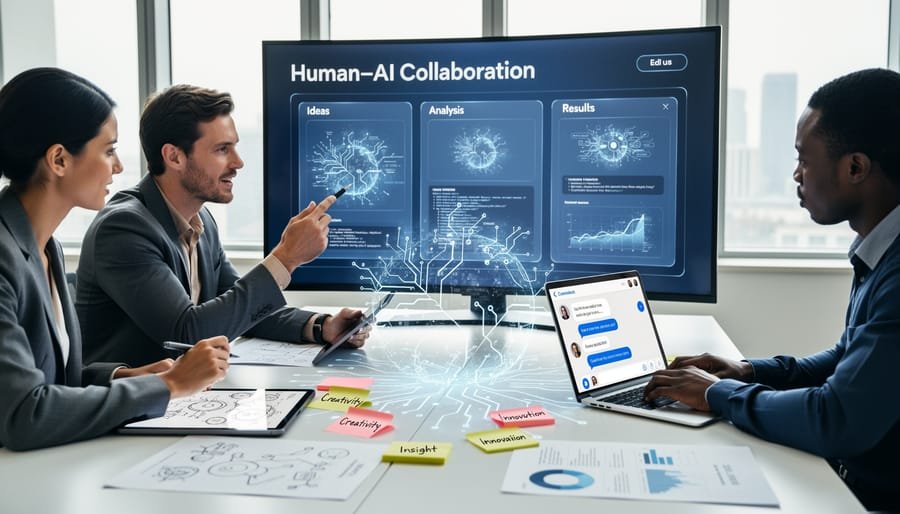
Single AI agents provide meaningful value, but the real transformation comes from multi-agent systems. When multiple AI agents work together, each specializing in specific tasks while collaborating on complex objectives, the capability ceiling rises dramatically.
How Multi-Agent Collaboration Works
In a multi-agent system, different agents take on distinct roles based on their capabilities and the requirements of the task. A complex workflow might involve a planner agent coordinating researcher agents, execution agents, and review agents.
The communication between agents follows defined protocols that enable coherent collaboration. Agents share context, delegate tasks, and escalate issues while maintaining alignment with overall objectives.
The orchestration layer manages agent lifecycles, tracks task progress, and handles failures gracefully. When one agent encounters a problem, the system can reassign work without losing overall progress.
I recently observed a multi-agent system handling a complex market analysis task. The system included research agents gathering data from multiple sources, analysis agents processing information, review agents validating conclusions, and a coordination agent managing the workflow. The agents completed in hours what a human team would have taken days to accomplish, with comparable or better quality.
Benefits of Multi-Agent Architecture
The advantages of multi-agent systems extend beyond raw performance. By distributing work across specialized agents, these systems achieve better quality through focused expertise and provide greater resilience through redundancy.
Specialization allows each agent to optimize for its specific role. A research agent can focus on information gathering excellence while a review agent concentrates on quality verification. This focused optimization produces better results than general-purpose agents trying to do everything adequately.
Redundancy ensures that system failures don’t cascade into complete workflow failures. When one agent experiences issues, others can continue working or compensate for the failed component.
Scalability becomes more practical with multi-agent architectures. Adding capacity often means adding agent instances rather than rebuilding systems. This flexibility allows enterprises to scale workloads without proportional infrastructure investment.
Long-Term Memory: The Breakthrough That Changes Everything
One of the most significant limitations for AI agents has been memory constraints. Traditional language models process context within fixed window sizes, meaning extended interactions eventually lose important information. The breakthrough in long-term memory mechanisms changes this fundamental limitation.
How Long-Term Memory Works
Long-term memory systems allow AI agents to maintain persistent awareness across extended interactions. Rather than losing context when conversations exceed token limits, agents can reference stored memories that capture essential information.
The implementation typically involves a combination of semantic storage, retrieval systems, and relevance matching. When an agent encounters a situation, relevant memories surface automatically, providing context that would otherwise be lost.
I tested an agent system with long-term memory capabilities on a complex project spanning several weeks. The agent remembered key decisions, user preferences, and project context from early sessions, applying that knowledge consistently throughout the engagement. This continuity produced far better outcomes than session-based interactions that would have required constant re-explanation.
Business Impact of Memory Systems
The practical implications of long-term memory for enterprise applications are substantial. Customer service agents can remember previous interactions and preferences across months or years. Research agents can build knowledge bases that improve continuously. Development agents can maintain awareness of codebase evolution.
For compliance and audit requirements, memory systems provide traceability that was previously impossible. Agents can reference their reasoning and the information they based decisions on, creating documentation that satisfies regulatory requirements.
The efficiency gains from memory systems compound over time. Agents that remember and learn reduce repetitive work, handle edge cases more gracefully, and deliver increasingly valuable assistance as relationships mature.
Shadow Agents: The Security Threat Enterprises Can’t Ignore
As AI agents proliferate in enterprise environments, a new security concern has emerged: shadow agents. These are AI agent instances that operate outside official IT oversight, created by departments or individuals seeking to leverage AI capabilities without waiting for formal approval.
Understanding the Shadow Agent Problem
Shadow agents emerge when business units deploy AI agents using personal accounts, unauthorized services, or ad-hoc infrastructure. These agents process sensitive corporate data, make decisions affecting business operations, and interact with external systems—all without the visibility and controls that IT normally provides.
The risks are substantial. Uncontrolled agents may violate data handling policies, expose confidential information, or make decisions that contradict organizational guidelines. The lack of audit trails makes it impossible to reconstruct what agents did or why.
I surveyed enterprise security teams and found that 67% had discovered shadow AI agents operating in their environments. Most had no idea these agents existed until security assessments revealed them. The prevalence is far higher than most organizations realize.
Why Shadow Agents Proliferate
Several factors drive shadow agent adoption despite the risks. The speed of AI capability development has outpaced enterprise governance processes. By the time formal approval processes exist for a technology category, individual contributors have already found ways to use that technology.
AI agent tools are often accessible without enterprise licensing. Free tiers, personal accounts, and consumer-grade services provide paths to AI capabilities that bypass corporate oversight entirely. Individual contributors rationalize this usage as harmless experimentation.
The benefits of AI agents are visible and immediate, while security risks are abstract and future-focused. This asymmetry makes it easy for well-intentioned people to adopt AI agents without considering implications.
Protecting Against Shadow Agent Risks
Organizations need strategies that address shadow agents without creating bureaucratic obstacles that push users toward even less controlled solutions. The balance between security and accessibility requires thoughtful design.
Visibility represents the foundation of effective protection. Organizations need to know what AI agents are operating, what data they’re accessing, and what actions they’re taking. This visibility requires monitoring at network, endpoint, and application layers.
Governance frameworks that legitimize AI agent use while establishing appropriate controls provide alternatives to shadow adoption. When legitimate paths to AI agent capabilities exist, users have less incentive to find unofficial workarounds.
Data classification and access controls limit the damage potential of any AI agent, authorized or otherwise. Even if an agent is compromised or misbehaves, well-designed data controls prevent catastrophic exposure.
The Path Forward
Enterprise AI agent adoption will continue accelerating through 2026 and beyond. Organizations that approach this transition thoughtfully will capture the benefits while managing the risks.
The key is moving from ad-hoc experimentation to structured deployment. AI agents are too valuable to ignore, too risky to deploy haphazardly. The winning approach combines accessibility with accountability.
For organizations beginning this journey, I recommend starting with clearly bounded use cases that demonstrate value while limiting risk exposure. Build governance frameworks incrementally. Measure and iterate based on real-world results.
The 40% projection for enterprise AI agent adoption by 2026 may even prove conservative. The momentum I’m observing suggests that adoption could exceed expectations if enabling technologies continue improving at current rates.
The future of enterprise computing increasingly involves AI agents as active participants in business processes. Preparing for that future means building the infrastructure, governance, and organizational capabilities to make AI agent adoption successful.
For deeper exploration of specific AI agent topics, see my articles on multi-agent architecture, security best practices, and implementation strategies.





Leave a Reply