REVERSE-ASIN DATA GUIDE
Cerebro can show that an ASIN appeared organically, in a sponsored placement, or in an Amazon-recommended set for a keyword. Those signals answer different questions. Combining them without context can turn a useful competitor report into a misleading keyword list.

Organic rank and sponsored rank are not interchangeable
| Signal | What it indicates | What it does not establish |
|---|---|---|
| Organic rank | The ASIN’s observed position in non-sponsored Amazon search results for the keyword. | Sales volume, conversion rate or permanent rank. |
| Sponsored rank | The ASIN’s observed position among sponsored placements for the keyword. | Bid, ad spend, profitability or exact campaign settings. |
| Amazon recommended | A relevance or advertising-related signal surfaced by Cerebro. | Guaranteed indexing, ranking or a recommendation to use the phrase in copy. |
Helium 10’s official Cerebro tutorial describes Sponsored Rank as the position where the product appeared when running a paid ad for a keyword, while Organic Rank refers to regular non-sponsored search placement. Both are snapshots and may change with time, location, inventory, bids and Amazon’s search environment.
Our paid-account case: overlapping keyword types
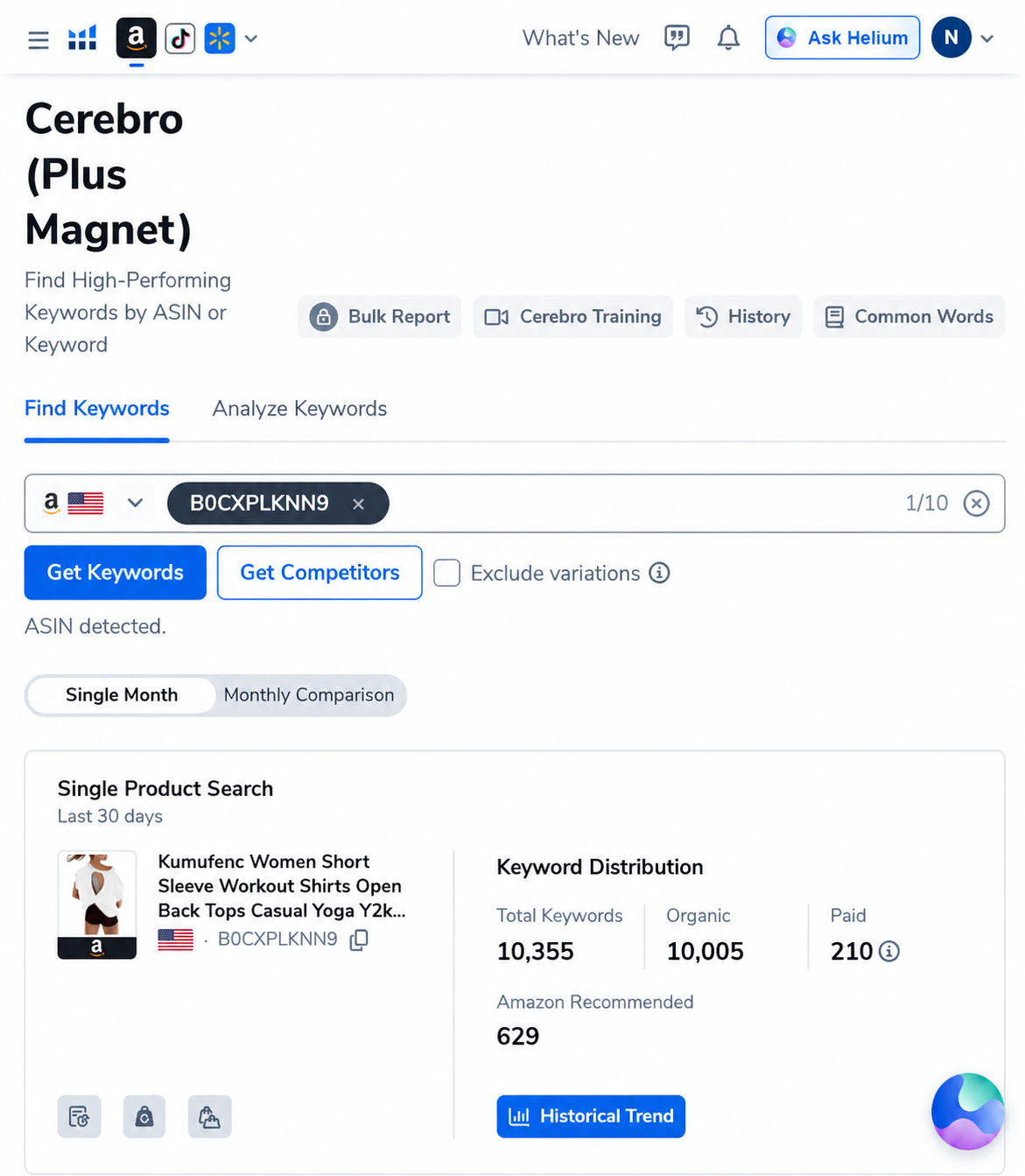
We ran one women’s open-back workout-top ASIN in a paid Helium 10 account. Cerebro returned 10,355 total keywords, including 10,005 organic, 210 sponsored and 629 Amazon-recommended signals. These types overlap, which is why the category figures should not be added together as if every keyword belonged to only one bucket.
How to interpret the four common patterns
1. Organic rank present, sponsored rank absent
The listing appeared organically in Cerebro’s observed range but no sponsored placement was detected for that snapshot. This can indicate established organic relevance, but it can also reflect a keyword that is not being advertised at that moment. Before increasing confidence, check whether the phrase accurately describes the product and whether rank persists over time.
2. Sponsored rank present, organic rank weak or absent
The seller may be buying visibility where organic presence is limited, or Cerebro may not have detected an organic position in its tracked range. This is a useful PPC research clue—not evidence that the ad converts or makes money. Treat it as a candidate for controlled testing rather than a phrase to copy blindly.
3. Strong organic and sponsored presence
The keyword appears important enough to support both visibility channels. For a close competitor, this can justify deeper analysis of shopper intent, listing placement and advertising. It can also be highly competitive, expensive or brand-led. Check multiple comparable ASINs before treating it as a category requirement.
4. Amazon-recommended signal without convincing rank
The signal may help discover relevant vocabulary, but recommendation alone is not proof of search performance. Validate the live results page and compare the phrase against product facts before using it in prominent copy.
A six-step competitor keyword workflow
- Choose genuinely comparable ASINs. Match product type, audience, price band and core use case. A best seller from an adjacent category can pollute the export.
- Record marketplace and date. Rank fields are time-sensitive observations.
- Remove literal mismatches. Wrong product, material, audience and branded phrases should not survive because of volume or rank.
- Compare several competitors. A phrase supported by multiple close ASINs is more informative than one outlier.
- Separate listing and PPC jobs. Organic relevance may support copy; paid-only visibility may belong in an ad test first.
- Measure after action. Track impressions, clicks, conversion and contribution margin rather than declaring success from the research tool.
Filtering reduces workload, not uncertainty
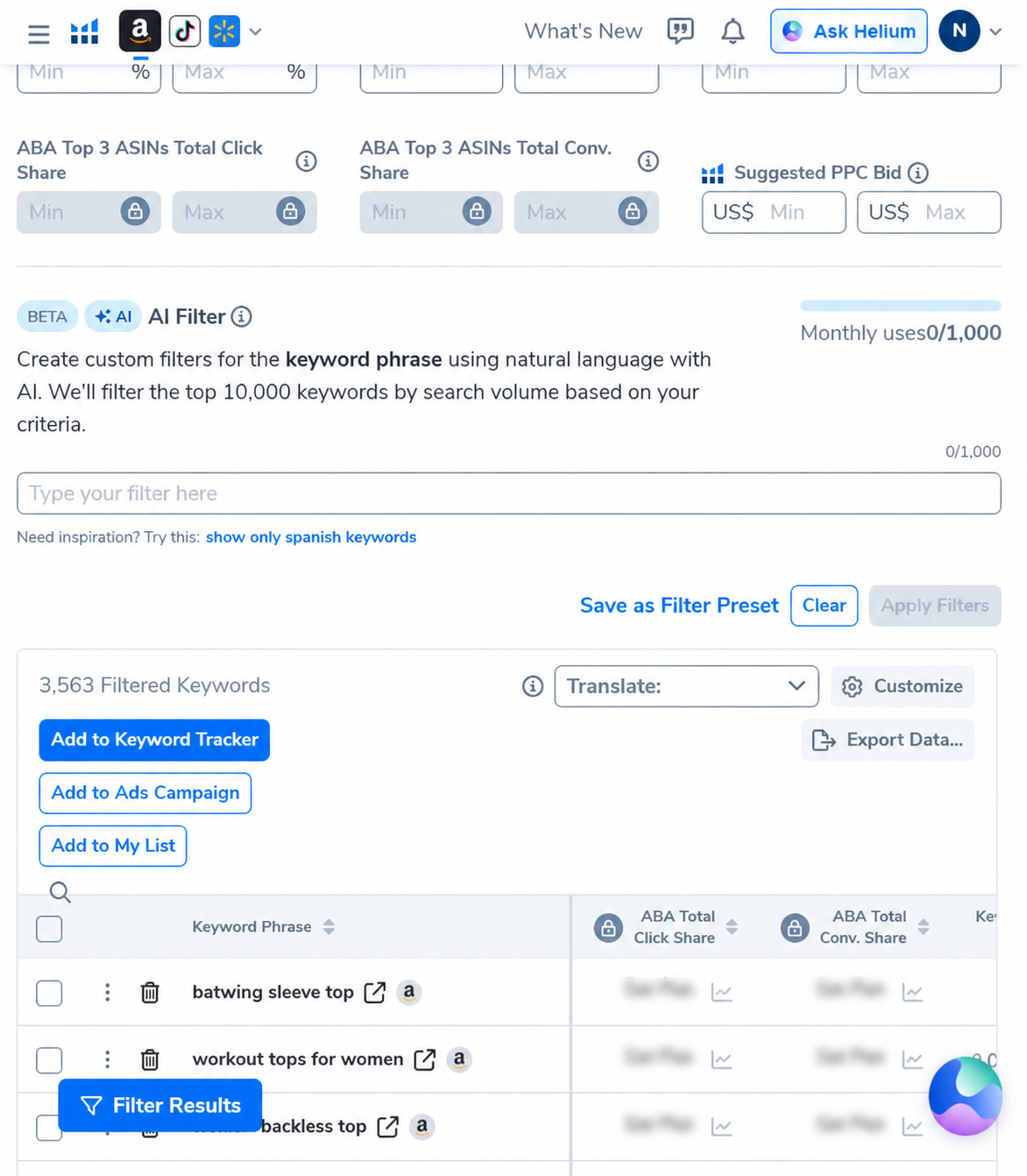
In the same paid-account case, a three-word minimum and a 500-search-volume floor reduced 10,355 keywords to 3,563. That 65.6% reduction made the result set easier to inspect, but it did not distinguish profitable sponsored terms from essential organic phrases.
Build separate organic and PPC shortlists
| Field | Organic shortlist | PPC shortlist |
|---|---|---|
| Minimum requirement | Literal product relevance and natural language fit. | Literal relevance plus a testable commercial hypothesis. |
| Primary evidence | Comparable ASINs ranking organically and live result-page fit. | Sponsored presence, buyer intent and acceptable test economics. |
| Destination | Title, bullets, description or backend indexing fields. | Exact, phrase or broad campaign test; sometimes product targeting. |
| Success metric | Indexing, rank trend, click-through and conversion. | Clicks, conversion, ACOS/TACOS and contribution margin. |
| Major risk | Keyword stuffing or misleading copy. | Paying for visibility without profitable conversion. |
When competitor sponsored rank is useful
Sponsored rank is most useful for generating questions: Which close competitors repeatedly advertise on this phrase? Is the query specific enough to suggest purchase intent? Does the live results page show products like yours? Can your margin support a meaningful test? It is less useful when treated as a proxy for a competitor’s private conversion rate or bid.
When organic rank deserves priority
Prioritize a phrase for listing evaluation when multiple close competitors rank organically, the search results match the intended product and the wording can be used accurately. A core phrase can remain strategically important even if its competition metrics look difficult. Conversely, a high-volume term that would make the listing misleading should be rejected.
Use word frequency to form clusters
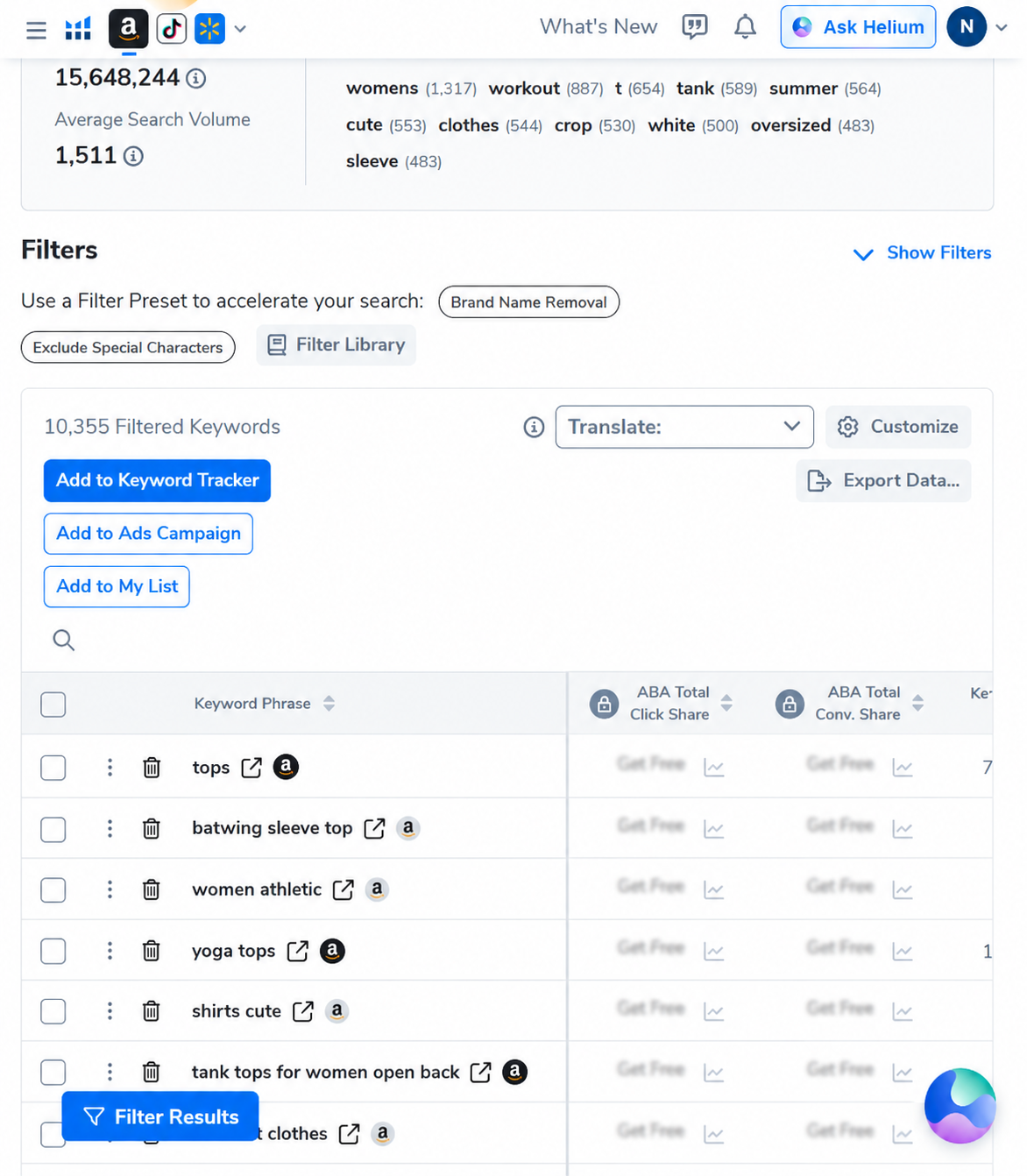
Word frequency can expose repeated features, use cases and audience modifiers before you inspect thousands of rows. Build clusters from recurring language, then return to complete phrases and rank types. Isolated words are not keywords, and frequency does not grant permission to use inaccurate or trademarked terms.
A decision log prevents hindsight bias
For every selected phrase, save the date, marketplace, source ASINs, organic evidence, sponsored evidence, relevance rationale, intended placement and success metric. After the listing or campaign runs, compare actual results with the original expectation. This turns Cerebro from a one-time export into a repeatable research process.
Common mistakes
- Assuming sponsored rank means the competitor is profitable.
- Assuming organic rank means the keyword caused sales.
- Mixing adjacent products into a multi-ASIN search.
- Copying branded or inaccurate phrases from competitors.
- Using one snapshot as a durable trend.
- Combining listing keywords and PPC tests into one undifferentiated spreadsheet.
- Ignoring price, fees, returns and advertising allowance.
AI PILOT DAILY EXCLUSIVE
Inspect organic and sponsored keyword signals in Cerebro
AIPILOTDAILY20 20% off the first 6 months of eligible monthly billing.
AIPILOTDAILY10 10% off eligible monthly billing on an ongoing basis.
View Helium 10 plans and apply a code →
Affiliate disclosure: we may earn a commission if you purchase through this link, at no extra cost to you. Confirm plan eligibility, offer duration and final pricing at checkout.
Frequently asked questions
What does organic rank mean in Helium 10 Cerebro?
It is the ASIN’s observed position in regular non-sponsored Amazon search results for the keyword. It is a snapshot, not a permanent rank or proof of sales.
What does sponsored rank mean in Cerebro?
It is the observed position of a sponsored placement associated with the ASIN and keyword. It does not reveal the seller’s bid, conversion rate or campaign profit.
Can the same keyword have organic and sponsored rank?
Yes. A listing can appear organically and through advertising for the same query. Evaluate the two visibility channels separately.
Should sponsored competitor keywords go directly into my campaign?
No. First verify product relevance, buyer intent, live search results and your test economics. Competitor visibility is a research clue, not a campaign instruction.
Next step: Apply Cerebro filters in the right order using our paid-account case study.
Keyword clustering: Use Cerebro Word Frequency to organize recurring product language.
Sources and methodology
Our screenshots and counts come from a paid Helium 10 account run in September 2026. Definitions were cross-checked against Helium 10’s official Cerebro tutorial, its organic and sponsored rank explanation, and its keyword research for PPC guide. Interface labels and results can change by marketplace, ASIN, account and date.