Real paid-account workflow · September 2026
How to Use Helium 10 Cerebro: A Real ASIN Keyword Case Study
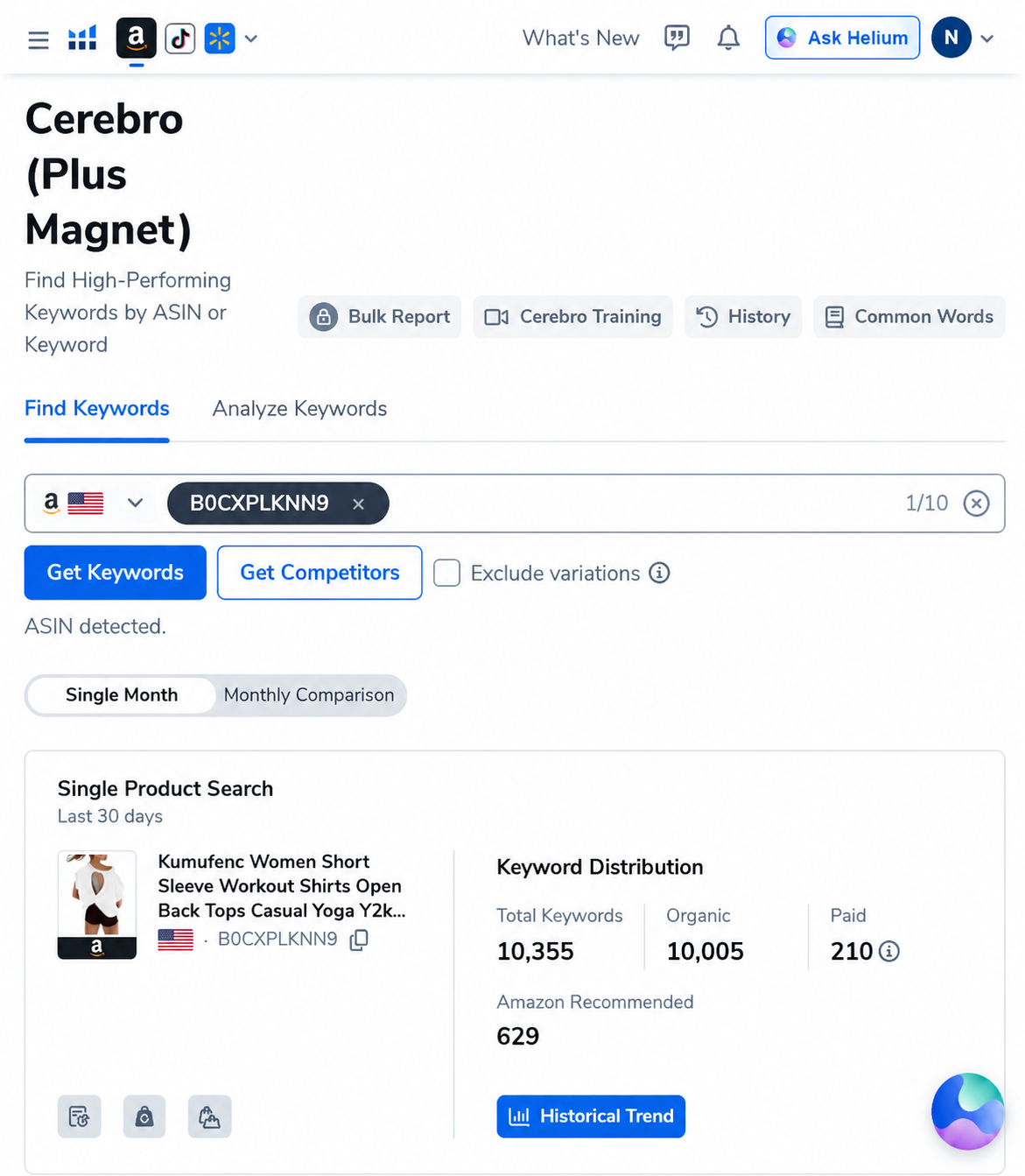
Helium 10 (H10) Cerebro is a reverse-ASIN research tool. We entered a real Amazon listing, reviewed 10,355 keyword associations, applied a simple long-tail filter and compared broad demand with product-specific relevance.
The case: one ASIN, no invented test claims
We used Amazon US ASIN B0CXPLKNN9, a women’s open-back workout top. This is the same listing used in our Black Box competitor case study, which makes the workflow reproducible across tools. We accessed the paid Cerebro interface; we did not purchase, sell or advertise this garment.
What the first result set tells us
A very broad discovery pool. It includes relevant phrases, adjacent-category terms and noise.
The ASIN appeared organically in the dataset for most recorded phrases; this does not mean it ranked highly for all of them.
Paid visibility was detected for a smaller group. It does not reveal campaign profit or conversion rate.
Cerebro also displayed 629 Amazon Recommended terms. This is useful as an association signal, but “recommended” should not be interpreted as Amazon promising traffic or sales.
Why the headline search volume is not the opportunity
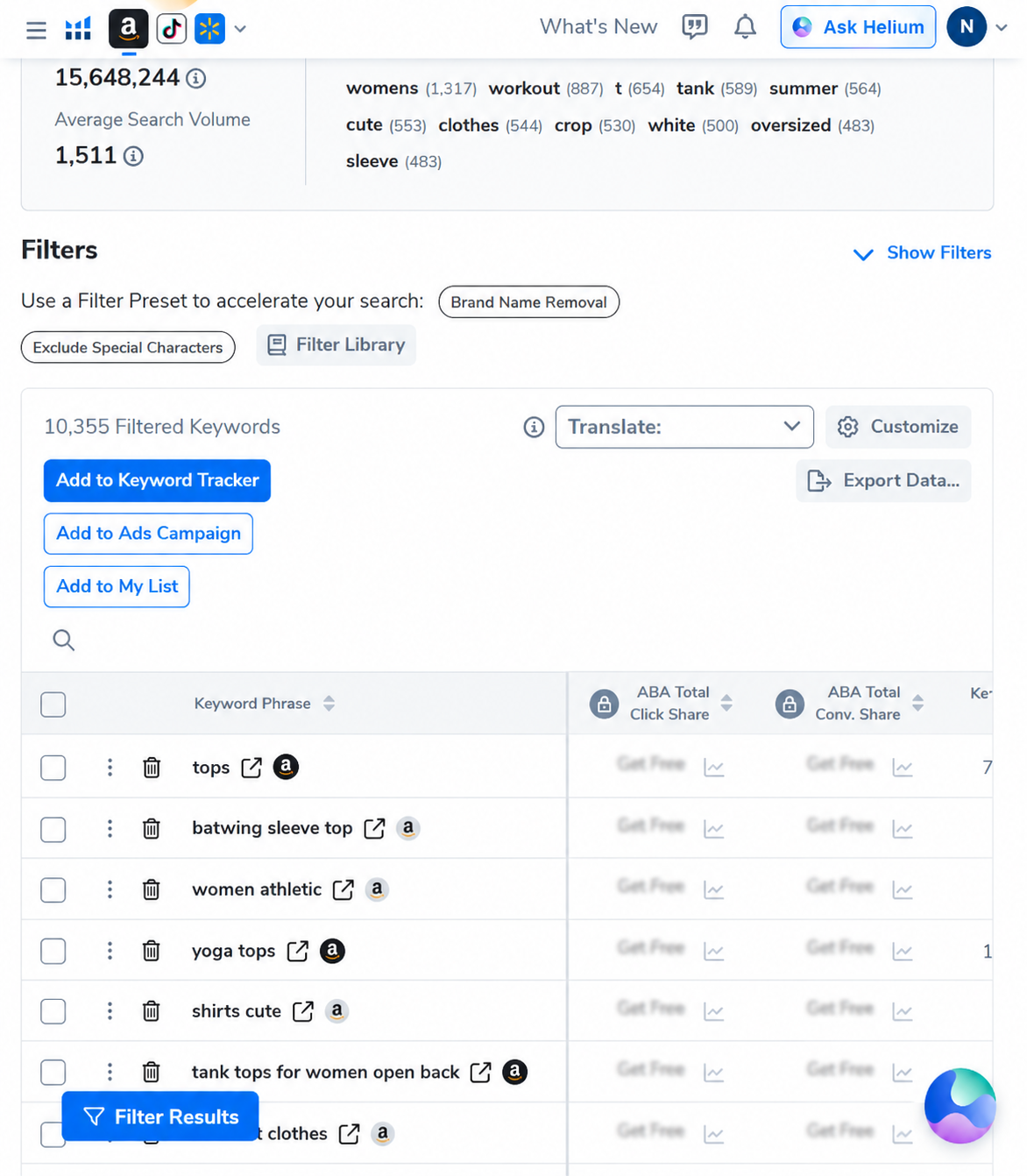
The unfiltered list showed total search volume of 15,648,244 and an average of 1,511. That aggregate is not a realistic traffic forecast for this product. It contains very broad phrases such as “tops” and “workout clothes,” where shopper intent, competition and product fit vary dramatically.
The word-frequency panel is more useful for understanding the language landscape. “Women,” “tops,” “shirts,” “workout,” “crop,” “white” and “oversized” reveal attributes Amazon shoppers use. The next job is to separate essential product descriptors from fashionable but inaccurate modifiers.
Our first filter: longer phrases with measurable demand
We set two transparent conditions:
- Minimum word count: 3 — reduces extremely broad one- and two-word phrases.
- Minimum search volume: 500 — keeps terms with a measurable demand signal in H10’s dataset.
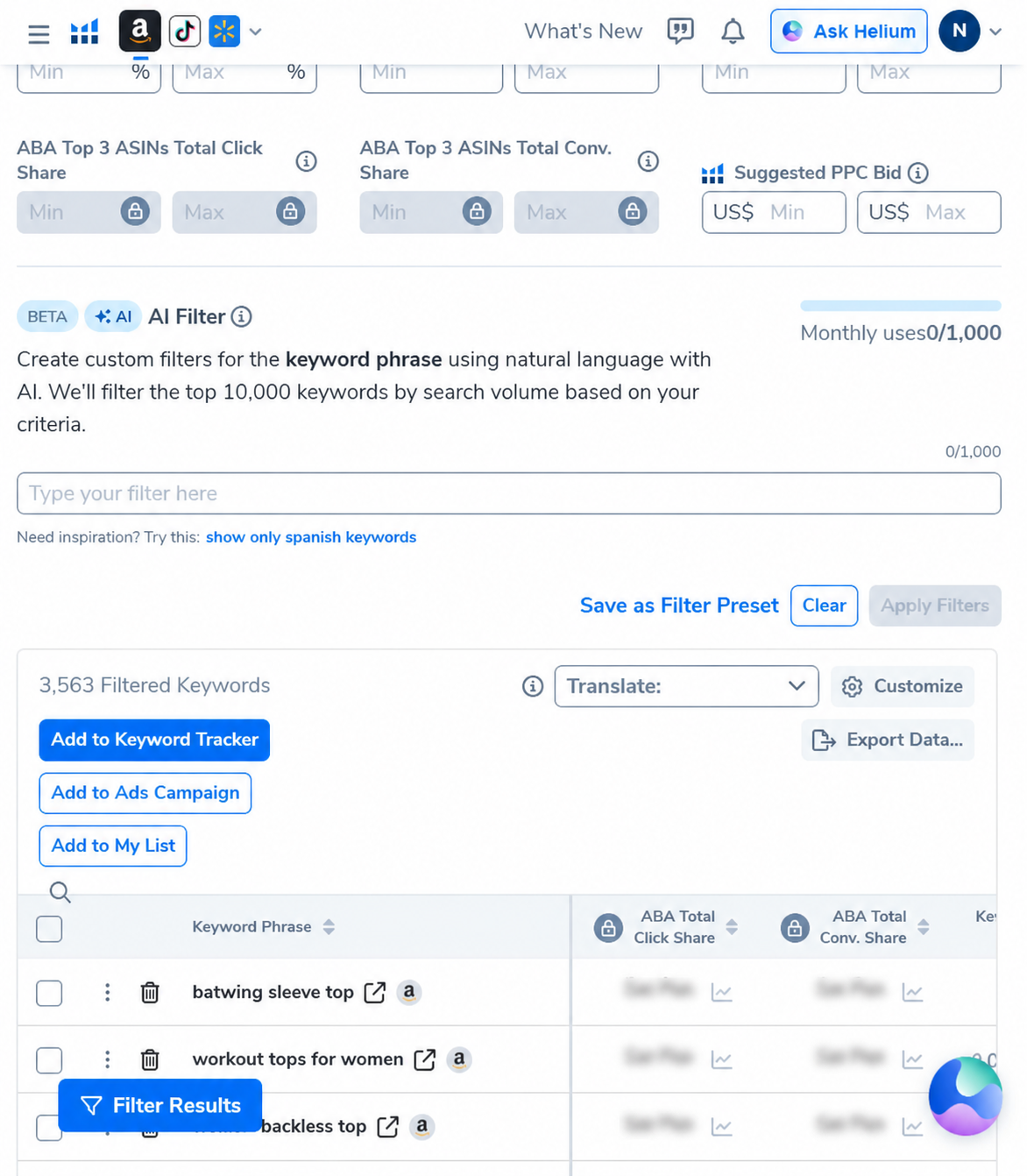
The result count fell from 10,355 to 3,563. The filtered total search volume shown by Cerebro changed to 8,623,791 and average search volume to 2,420. This is still far too large for a final keyword list, but it is a better working set.
Three keywords show why relevance beats volume
| Keyword | Visible H10 data | Decision |
|---|---|---|
| workout tops for women | Search volume 134,764; trend −7%; suggested PPC bid .54 (.35–.70); keyword sales 2,086; competing products >50,000; title density 8; organic rank 3. | High-demand core phrase and highly relevant, but extremely broad competition. Keep as a primary semantic term; do not assume it will be cheap to rank. |
| open back workout top | Search volume 3,324; trend +5%; suggested PPC bid .63 (.46–.76); keyword sales 60; competing products >4,000; title density 2; organic rank 1. | Lower volume but much closer product fit. Strong candidate for title/bullet coverage if the product is genuinely open-back. |
| backless workout tops for women | Search volume 1,211; trend −10%; suggested PPC bid .52 (.45–.66); keyword sales 1; competing products >4,000; title density 1; organic rank 1. | Semantically precise, but the low visible keyword-sales signal and negative trend argue for secondary placement and further validation. |
A practical Cerebro workflow
- Choose one directly relevant ASIN, then repeat with two or three true competitors.
- Keep the marketplace consistent; search behavior differs by country.
- Review distribution and word frequency before filtering.
- Remove brand terms and unrelated styles unless comparison intent requires them.
- Use minimum word count and search volume only as a first pass.
- Prioritize phrases that accurately describe the product and show plausible demand.
- Compare organic rank, sponsored rank, trend, keyword sales, title density and competing products.
- Group final terms by core intent, attribute, use case and audience.
- Verify wording on live Amazon results and avoid trademarked or misleading terms.
- Send the final shortlist—not the full export—to Listing Builder or Keyword Tracker.
What we would do next with this listing
We would run two additional ASINs that match the same open-back, short-sleeve design and compare overlap. We would retain “workout tops for women” as a broad category phrase, test “open back workout top” as the strongest specific phrase, and avoid stuffing unrelated terms such as compression shirts or multipack language. A multi-ASIN comparison would also reduce the risk of copying quirks from one listing.
AI Pilot Daily reader codes
Run the same Cerebro workflow
Use the direct partner link, then enter the code at checkout. Confirm the final plan, price and duration before paying.
AIPILOTDAILY2020% off the first 6 months on eligible monthly checkout, as observed in our checkout.
Open Helium 10 with AIPILOTDAILY20 →
AIPILOTDAILY1010% ongoing on eligible monthly checkout, shown as “forever” in our test.
Check plans with AIPILOTDAILY10 →
Affiliate disclosure: We may earn a commission if you purchase through these links, at no extra cost to you. Prices, plan access and promotions can change; verify the checkout terms.
Frequently asked questions
What does Helium 10 Cerebro do?
It finds keyword associations and ranking signals for one or more Amazon ASINs, helping sellers build and prioritize a keyword set.
How many ASINs should I enter?
One ASIN is useful for diagnosis. Several genuinely comparable ASINs are better for finding shared terms and reducing single-listing bias.
Is higher search volume always better?
No. A lower-volume phrase with precise product fit can be more useful than a broad phrase with weak intent and heavy competition.
Are Cerebro sales and search-volume figures exact?
No. Treat them as third-party estimates for comparison and prioritization, not audited Amazon seller-account figures.
What is the difference between Cerebro and Magnet?
Cerebro starts from ASINs to reveal associated keywords. Magnet usually starts from a seed keyword to discover related phrases.
Next step: Apply Cerebro filters in the right order using our paid-account case study.
Keyword clustering: Use Cerebro Word Frequency to organize recurring product language.
Sources and methodology
We captured the paid Cerebro interface and recorded the displayed figures on September 5, 2026. We also checked Helium 10’s official knowledge-base material for Cerebro workflows. Interface, estimates and plan access may change.
Continue: Black Box ASIN case study · Full Helium 10 review · Verified coupon tests
Cerebro reading path