PAID-ACCOUNT KEYWORD CLUSTERING GUIDE
Cerebro Word Frequency counts repeated terms across a reverse-ASIN result set. It is useful for discovering product language and diagnosing a noisy competitor set—but frequency alone does not show buyer intent, conversion or profitability.
What Cerebro Word Frequency shows
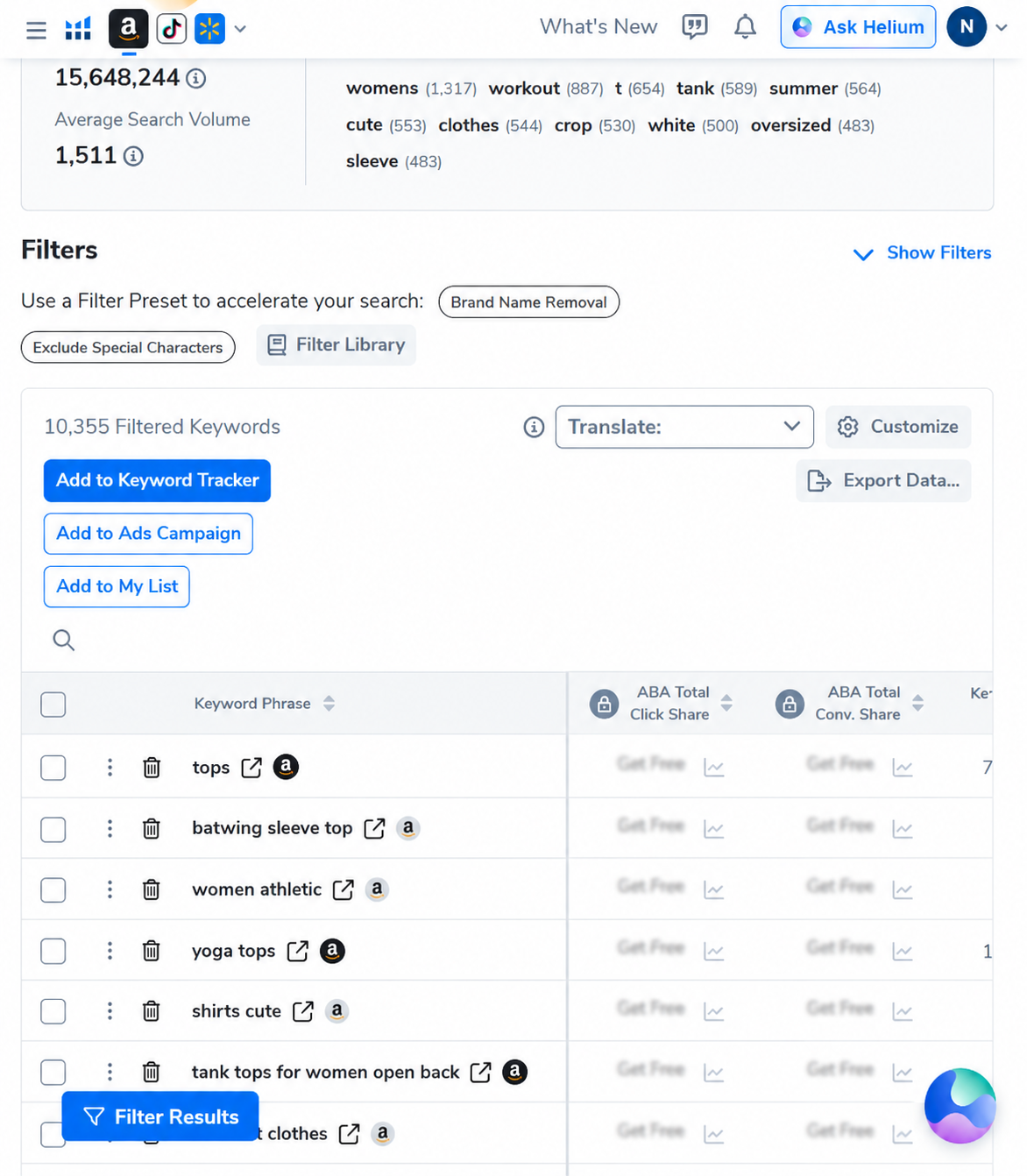
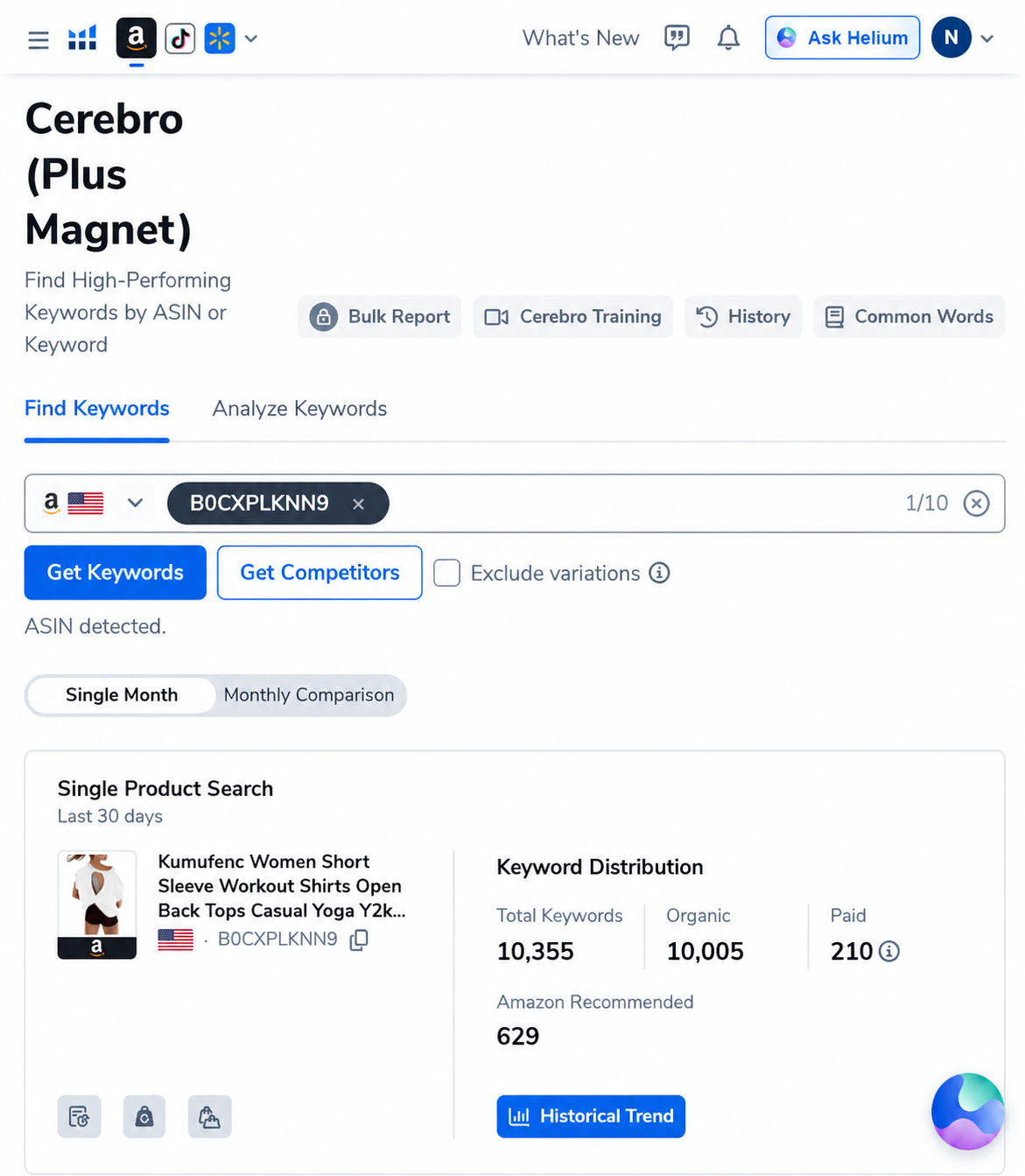
In our September 2026 paid-account query, one women’s open-back workout-top ASIN produced 10,355 keyword records. Cerebro displayed 15,648,244 in total estimated search volume and 1,511 average estimated search volume before filtering. The visible recurring vocabulary included terms such as women, tops, shirts, workout, tank, summer, crop, white and oversized.
How to read the recurring words
| Theme | Examples from the dataset | What to investigate |
|---|---|---|
| Product nouns | tops, shirts, tank | Whether each noun accurately describes the item and how shoppers distinguish formats. |
| Audience | women | Whether the audience term is accurate and required in prominent copy. |
| Use case | workout | Whether the product supports that activity and whether complete phrases show commercial intent. |
| Style or attribute | crop, oversized, white | Whether the attribute matches the exact variation being sold. |
| Seasonality | summer | Whether demand is seasonal and whether the research date distorts prioritization. |
A six-step workflow
1. Verify the ASIN set
Repeated irrelevant nouns often indicate that one competitor belongs to another product segment. Compare silhouette, audience, pack count, material, price band and intended use before trusting the vocabulary.
2. Save the unfiltered baseline
Record marketplace, date, ASINs, total keyword count and estimated volume. This makes later filter choices reproducible instead of arbitrary.
3. Sort words into semantic buckets
Create buckets for core product, audience, feature, material, use case, style, season and brand. Add an exclusion bucket for words that describe the wrong item. This produces a vocabulary map before numeric thresholds remove context.
4. Open complete phrases
A word such as “crop” can appear in relevant and irrelevant queries. Review the complete query, live search results and product accuracy. Frequency is the pointer; the phrase is the unit of intent.
5. Apply filters for the job
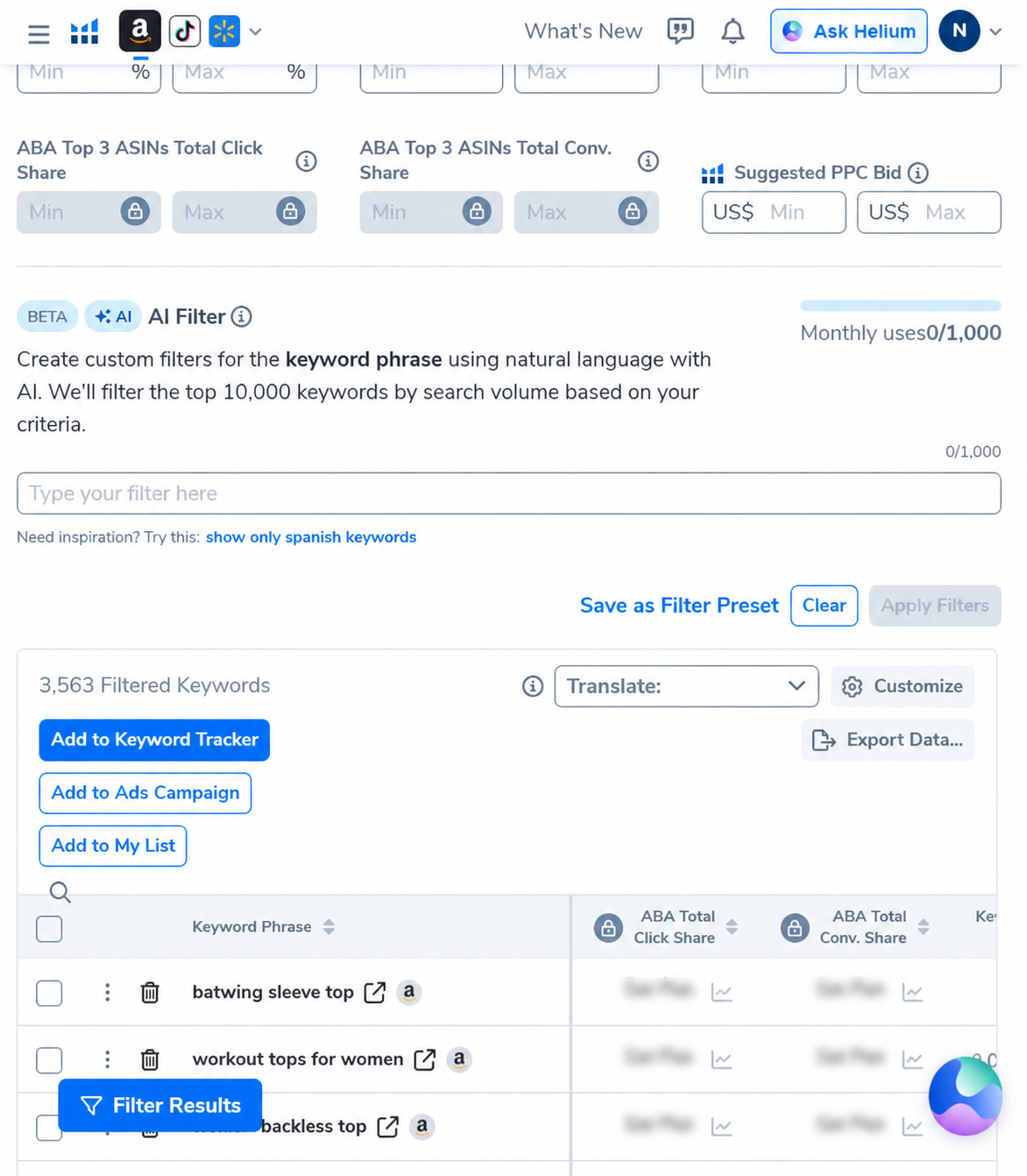
For listing copy, prioritize literal accuracy and natural phrasing. For PPC testing, separate exact commercial queries from broader discovery themes. For market research, retain adjacent language until the segments are understood.
6. Assign every cluster a destination
Map a cluster to the title, bullets, description, backend terms, exact-match PPC, discovery PPC or negative-keyword review. If a cluster has no valid destination, it is not yet actionable.
Word Frequency as an ASIN-quality test
The panel is especially valuable when multiple competitors are queried. Add ASINs one at a time and watch which vocabulary themes appear. If a new ASIN introduces unrelated product nouns or audiences, remove it and rerun the search. This is more defensible than compensating for a bad competitor set with increasingly strict numeric filters.
What Word Frequency cannot prove
- That a repeated word converts.
- That it belongs in the title.
- That a keyword is easy to rank for.
- That estimated search volume is exact.
- That a competitor is profitable.
- That seasonal vocabulary will remain stable.
- That a trademark or brand term is safe to use.
Example cluster worksheet
| Cluster | Evidence to collect | Possible destination |
|---|---|---|
| Core product | Several close competitors rank; phrase accurately names the item. | Title or first bullet. |
| Feature | Feature exists on the sold variation and appears in relevant complete phrases. | Bullet or description. |
| Use case | Live results and customer language match the intended activity. | Bullet, image copy or PPC test. |
| Adjacent discovery | Meaning is related but not precise enough for prominent copy. | Bounded phrase/broad campaign. |
| Mismatch | Wrong material, audience, product type or pack format. | Exclude or negative-keyword review. |
AI PILOT DAILY EXCLUSIVE
Run the same Cerebro workflow
AIPILOTDAILY20 20% off the first 6 months of eligible monthly billing.
AIPILOTDAILY10 10% off eligible monthly billing on an ongoing basis.
Check Helium 10 plans and apply a code →
Affiliate disclosure: we may earn a commission if you purchase through this link, at no extra cost to you. Confirm eligibility, duration and final pricing at checkout.
Frequently asked questions
What is Helium 10 Cerebro Word Frequency?
It is a view that surfaces words repeated across the keyword results associated with the queried ASINs. It helps reveal vocabulary themes and possible noise.
Should frequent words automatically go into an Amazon listing?
No. Review complete phrases, product accuracy, buyer intent and Amazon search results before assigning any term to listing copy.
Can Word Frequency help choose competitor ASINs?
Yes. Unrelated recurring vocabulary can expose an ASIN from another product segment, but the conclusion should be confirmed by comparing the actual listings.
Is Word Frequency the same as search volume?
No. Frequency counts recurrence in the result set; search volume is Helium 10’s estimate of query demand. They answer different questions.
Methodology and limitations
The screenshots and displayed figures come from a paid Helium 10 account captured in September 2026. We did not sell or advertise the example garment. Metrics are used as comparative research signals, not audited Amazon sales or guaranteed outcomes. Tool interfaces and estimates can change by marketplace, ASIN, account and date.