
Semrush AI Visibility Toolkit Alternative for Smaller Brands
Quick Answer
Semrush’s AI Visibility Toolkit is built for serious AI search monitoring, competitor research, prompt tracking, and presentation-ready reporting. It is useful for SEO teams and larger marketing organizations.
But smaller brands often need a lighter starting point:
- Is AI mentioning my brand?
- Why are competitors showing up instead?
- Is my website cited?
- Which prompts am I losing?
- Which sources does AI trust?
- What should I fix next?
If you want a simpler first scan, start here:
Run a free AI Brand Visibility check: CommerceGrowthKit AI Brand Visibility Checker
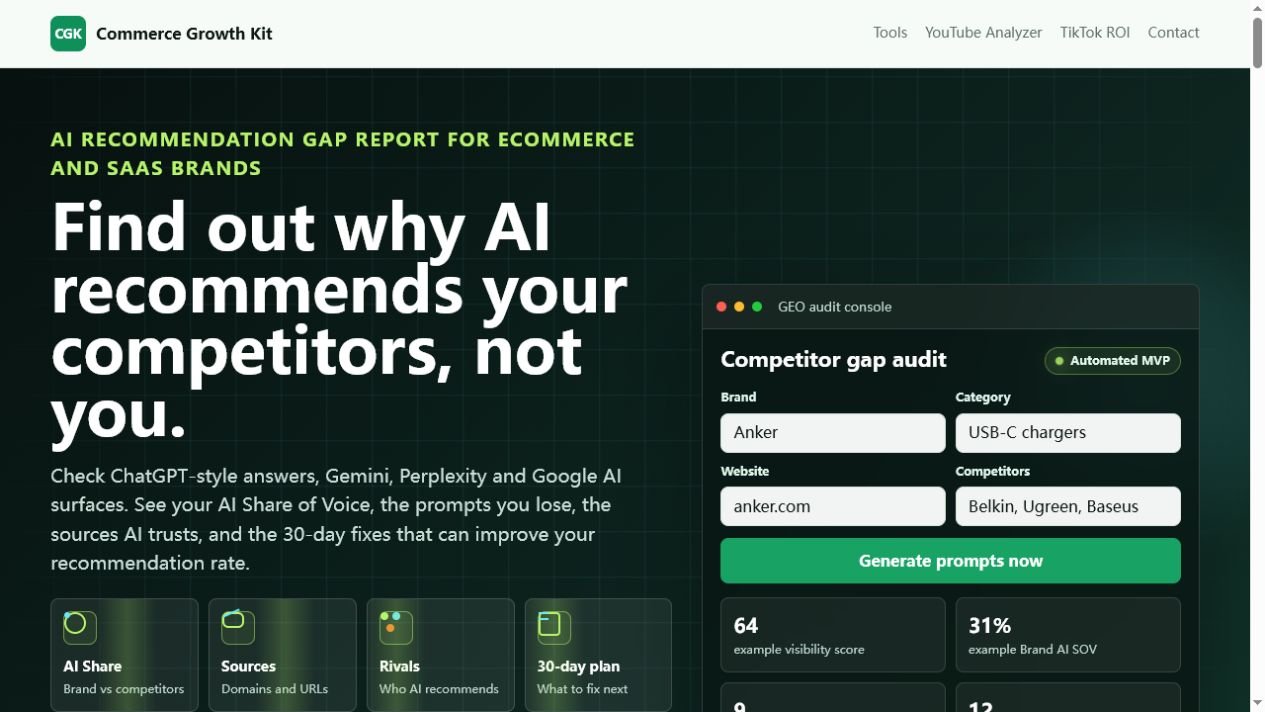
Try the lighter workflow: Run a free AI brand visibility scan
Why People Search For A Semrush AI Visibility Toolkit Alternative
Semrush is one of the strongest SEO platforms in the market. Its AI Visibility Toolkit reflects that strength: large datasets, competitor research, prompt databases, sentiment, technical audits, and reporting.
For many teams, that is exactly what they need.
But smaller brands, ecommerce operators, DTC founders, Amazon sellers, and agencies often start with a simpler problem:
They do not yet know whether AI recommends them at all.
Before they need enterprise-scale monitoring, they need a first answer:
- Does ChatGPT mention us?
- Does Perplexity cite us?
- Does Gemini recommend competitors?
- Which competitor appears most often?
- What content gap should we fix first?
That is why a lighter alternative can make sense.
What Semrush AI Visibility Toolkit Does Well
Based on Semrush’s public documentation, the AI Visibility Toolkit helps teams:
- Benchmark AI visibility and brand mentions
- Analyze perception and sentiment compared with competitors
- Discover prompts and topics to target
- Track daily AI visibility for important prompts
- Audit sites for technical issues that may block AI crawlers
- Identify competitive gaps and opportunities
- Create presentation-ready reports
Semrush also documents a prompt database and competitor research workflow that can identify topics and prompts where rivals appear but your brand is missing.
That is valuable.
It confirms where the market is going:
AI search optimization is becoming measurable, competitive, and report-driven.
Where Smaller Brands Need A Different Workflow
Smaller brands do not always need the biggest dataset on day one.
They need a clear decision workflow.
| Enterprise Platform Need | Smaller Brand Need |
|---|---|
| Large prompt database | 8-20 high-intent buyer prompts |
| Advanced monitoring | First visibility snapshot |
| Multiple dashboards | One clear report |
| Presentation-ready exports | Founder-friendly action plan |
| Broad competitor research | 3-5 direct rivals |
| Full technical audit | Immediate website/source gaps |
For smaller teams, the main goal is not to admire a dashboard.
The goal is to decide what to do next.
What A Lighter Alternative Should Include
A practical Semrush AI Visibility Toolkit alternative for smaller brands should include these modules.
1. Brand Mention Check
Does AI mention the brand in buyer prompts?
This is the basic signal.
If the answer is no, the brand likely has a category association problem.
2. Competitor Share
Which rivals appear instead?
This helps the team see whether the problem is general invisibility or a specific competitor advantage.
3. Website Citation Check
Does AI cite the brand’s own website?
If not, the website may lack useful source pages, crawlable content, or trusted material.
4. Prompt Wins And Losses
Which questions mention the brand?
Which questions mention only competitors?
This is where content strategy starts.
5. Cited Domains
Which third-party domains does AI rely on?
For ecommerce brands, these may include:
- Review sites
- Reddit threads
- YouTube videos
- Amazon pages
- Affiliate roundups
- Media articles
- Comparison pages
6. Source Gap
Which trusted sources mention competitors but not the brand?
This is one of the most useful outputs because it turns AI visibility into outreach, PR, review, and content tasks.
7. 30-Day Action Plan
The report should tell the user what to do next:
- Fix category page
- Add comparison page
- Build FAQ
- Earn review mentions
- Improve product documentation
- Create alternatives page
Without next actions, AI visibility data is just another chart.
When Semrush Is The Better Choice
Semrush is likely a better fit when:
- You already have a mature SEO team
- You need large-scale prompt databases
- You want integrated SEO and AI visibility workflows
- You manage many regions
- You need broad competitive intelligence
- You can justify a larger monthly platform cost
For enterprise teams, this depth matters.
If your team is already using Semrush heavily, its AI Visibility Toolkit may fit naturally into your workflow.
When A Lightweight Checker Is Better
A lightweight checker is better when:
- You are testing whether GEO matters for your brand
- You need a quick snapshot
- You only care about a few competitors
- You want a founder-friendly report
- You need to show the problem before buying a larger platform
- You are an agency creating a first audit for a client
- You need a practical fix list, not just raw visibility data
This is where a simple AI brand visibility scan can be useful.
Comparison Table
| Feature | Semrush AI Visibility Toolkit | Lightweight AI Brand Visibility Checker |
|---|---|---|
| Best for | SEO teams and larger orgs | Smaller brands, founders, agencies |
| Prompt coverage | Large prompt database | Focused buyer prompts |
| Competitor tracking | Advanced | Direct competitor set |
| Website citations | Yes | Yes |
| Source gaps | Yes | Should be included |
| Setup | Platform workflow | Fast scan |
| Output | Dashboard/reporting | Action-focused report |
| Main value | Scale and depth | Speed and clarity |
The Real Buying Question
The real question is not:
Which tool has the most features?
The better question is:
What level of AI visibility insight does my team need right now?
If you are already running a mature SEO operation, you may need a full platform.
If you are just starting, you may need to answer three practical questions first:
- Does AI mention us?
- Why do competitors win?
- What should we fix this month?
That is the wedge for smaller brands.
What A Good First Report Looks Like
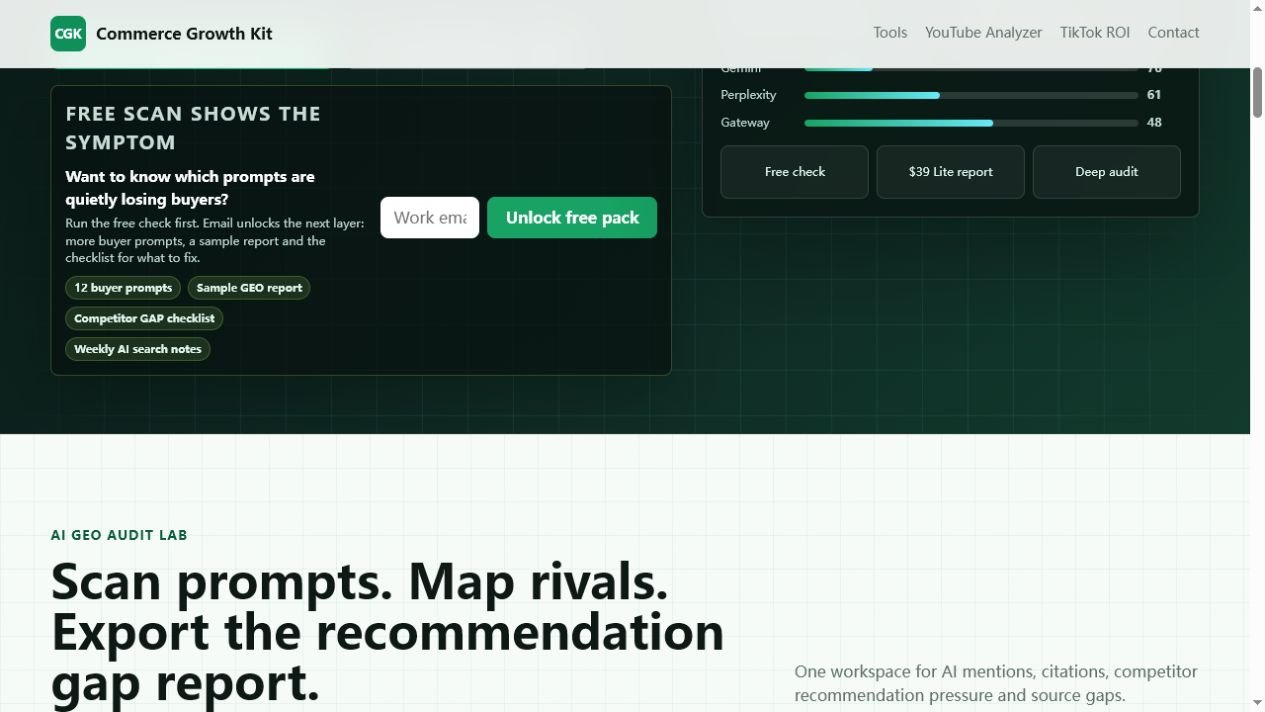
See the report workflow: Open the AI visibility report demo
A useful first report should show:
- Visibility score
- Brand mentions
- Competitor mentions
- Competitor share
- Website citations
- Prompt wins and losses
- Cited domains
- Source gaps
- Content gaps
- 30-day action plan
That gives the founder, marketer, or client a practical map.
A Simple Decision Framework
Use a lightweight checker if:
- You are early in GEO
- You need a fast diagnosis
- You want to test buying intent
- You need a quick client audit
- You care most about next actions
Use a larger platform if:
- You need ongoing monitoring at scale
- You manage many brands or regions
- You need historical trends
- You need deep competitor datasets
- You already have SEO ops maturity
Both can be valid.
The key is matching the tool to the stage.
FAQ
Is Semrush AI Visibility Toolkit good?
Yes. It is a serious platform for AI visibility, prompt research, competitor benchmarking, and reporting.
Why look for an alternative?
Smaller brands may want a faster, simpler, lower-friction way to understand whether AI mentions them and why competitors win.
What should an alternative measure?
At minimum: brand mentions, competitor mentions, AI Share of Voice, website citations, cited domains, prompt gaps, and next actions.
Is AI visibility different from SEO visibility?
Yes. SEO visibility measures search rankings and traffic. AI visibility measures how brands appear in AI-generated answers.
Final Recommendation
If you are a mature SEO team, evaluate Semrush’s AI Visibility Toolkit seriously.
If you are a smaller brand, start with a focused visibility scan first.
Find out:
- Whether AI mentions your brand
- Which competitors are recommended
- Whether your website is cited
- Which prompts you lose
- Which source gaps need attention
Start here:
Run a free AI Brand Visibility Checker: https://commercegrowthkit.com/ai-brand-visibility-checker/
Sources
- Semrush AI Visibility Toolkit: https://www.semrush.com/kb/1493-ai-visibility-toolkit
- Semrush Competitor Research Report: https://www.semrush.com/kb/1598-competitor-research-report
- Semrush AI Visibility Data: https://www.semrush.com/kb/1607-semrush-ai-visibility-data
- Ahrefs Brand Radar: https://ahrefs.com/brand-radar
- Ahrefs Brand Radar Overview: https://ahrefs.com/academy/how-to-use-brand-radar/overview
