
AI Share of Voice: How to Measure Your Brand Against Competitors in ChatGPT and Perplexity
Quick Answer
AI Share of Voice measures how often your brand appears in AI-generated answers compared with competitors for the prompts that matter in your category.
In traditional SEO, brands watched keyword rankings and search traffic. In AI search, the new question is different:
When a buyer asks ChatGPT, Perplexity, Gemini, Claude, or Google AI answers for recommendations, does your brand appear or does a competitor get the mention?
That is what AI Share of Voice helps you measure.
You can start with a free scan here:
Run a free AI Brand Visibility check: CommerceGrowthKit AI Brand Visibility Checker
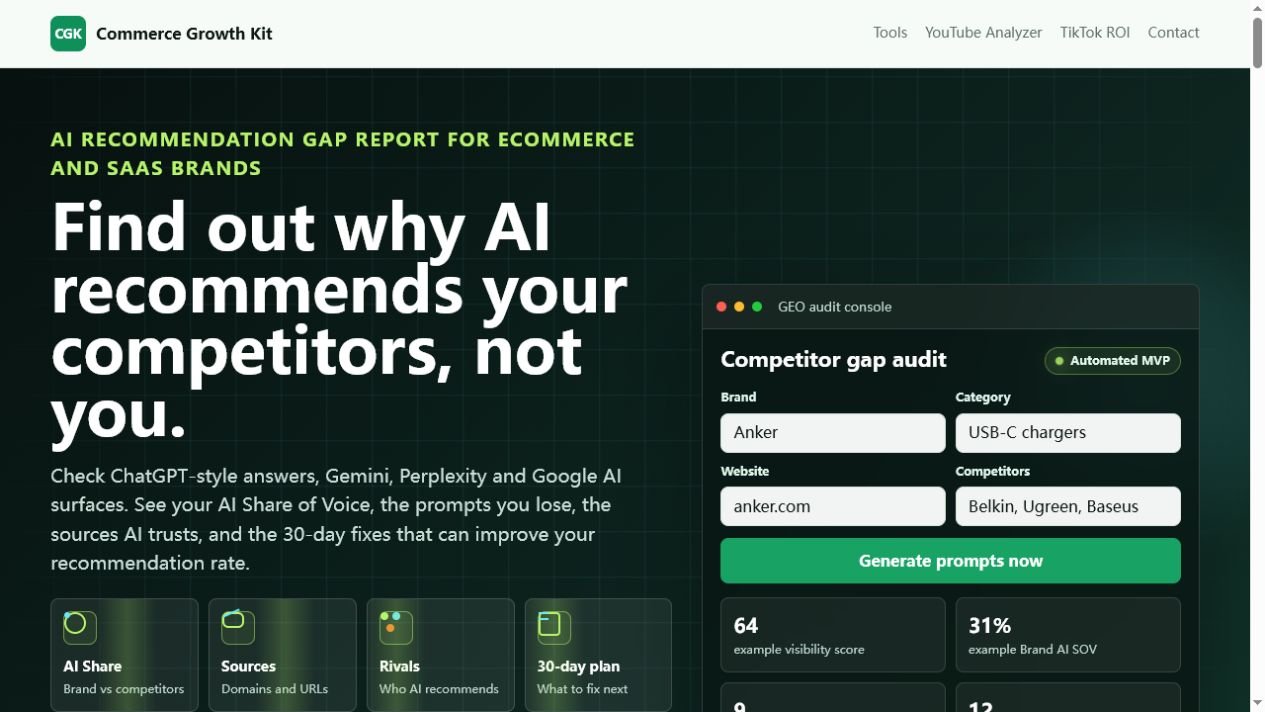
Try it: Measure your AI Share of Voice with CommerceGrowthKit
What Is AI Share of Voice?
AI Share of Voice is a competitive visibility metric.
It compares how often your brand appears in AI answers against a defined set of competitors.
For example, imagine you sell USB-C chargers and your competitor set is:
- Anker
- Belkin
- Ugreen
- Baseus
- Satechi
You test 20 buyer prompts across ChatGPT, Perplexity, Gemini, and Claude.
If your brand appears in 6 answers, Anker appears in 15 answers, and Ugreen appears in 10 answers, your AI Share of Voice is lower than those competitors.
The exact calculation can vary by tool, but the core idea is simple:
Of all AI recommendation visibility in this category, how much belongs to your brand?
Ahrefs Brand Radar describes AI visibility with metrics such as mentions, citations, impressions, and AI Share of Voice. Semrush’s AI Visibility Toolkit also focuses on brand mentions, competitor benchmarks, prompt gaps, and AI-generated answer visibility.
The important point is this: AI visibility is no longer just a feeling. It can be measured.
Why AI Share of Voice Matters Now
Buyers are starting to use AI as a recommendation layer.
Instead of searching through many pages, they ask:
- What are the best brands for this category?
- Which brand is most reliable?
- Which product should I buy for this use case?
- Compare Brand A with Brand B.
- What are the best alternatives to Brand X?
If AI recommends your competitors, the buyer may never search your brand directly.
That changes how brand discovery works.
Traditional SEO still matters. But it is not enough to only ask:
- Do we rank on Google?
- How much organic traffic do we get?
- Which keywords are improving?
You also need to ask:
- Does AI mention us?
- Does AI cite our website?
- Which competitors appear more often?
- Which prompts do we win or lose?
- Which sources does AI trust?
- What should we fix next?
That is the practical value of AI Share of Voice.
The Core Metrics To Track
A useful AI Share of Voice report should include more than one score.
| Metric | What It Tells You |
|---|---|
| Brand mentions | Whether your brand appears in AI answers |
| Competitor mentions | Which rivals AI recommends instead |
| AI Share of Voice | Your relative visibility versus competitors |
| Website citations | Whether AI cites your own domain |
| Cited domains | Which sources AI trusts |
| Prompt wins | Questions where your brand appears |
| Prompt losses | Questions where competitors appear and you do not |
| Model difference | Whether ChatGPT, Perplexity, Gemini, or Claude behave differently |
| Source gap | Which trusted websites cite competitors but not you |
| Next actions | What to create, fix, or earn next |
The mistake is treating AI visibility like one vanity score.
The value is in the breakdown.
How To Measure AI Share of Voice Manually
You can start without a paid platform.
Step 1: Choose One Category
Pick the category buyers actually use.
Bad examples:
- smart lifestyle solution
- next-generation commerce platform
- premium innovation brand
Better examples:
- USB-C charger
- air purifier for allergies
- Shopify influencer marketing tool
- Amazon keyword research tool
- AI meeting note taker
AI answers work best when prompts use plain buyer language.
Step 2: Choose 3-5 Competitors
Do not only choose the biggest competitor.
Include:
- The category leader
- A cheaper alternative
- A premium alternative
- A brand that appears in reviews
- A marketplace or app-store leader
The goal is to model how real buyers compare options.
Step 3: Create Buyer Prompts
Use prompts from different buyer stages.
| Prompt Type | Example |
|---|---|
| Best brands | What are the best [category] brands for [audience]? |
| Comparison | Compare [brand] and [competitor]. Which one is better? |
| Alternative | What are the best alternatives to [competitor]? |
| Trust | Is [brand] a trustworthy [category] brand? |
| Source-seeking | Mention useful sources or reviews if possible. |
| Use case | Which [category] is best for [specific need]? |
Do not only test branded prompts.
The commercial value is in non-branded buyer discovery prompts.
Step 4: Test Across Multiple AI Engines
Run the same prompt set across:
- ChatGPT
- Perplexity
- Gemini
- Claude
- Google AI Overviews or AI Mode where available
Each engine may produce different answers, sources, and recommendations.
Perplexity may show citations more clearly. ChatGPT may summarize from broader patterns. Gemini may behave differently because of Google’s ecosystem. Claude may produce more cautious answers.
That is why model-level comparison matters.
Step 5: Score The Answers
For every answer, record:
- Was your brand mentioned?
- Was your website cited?
- Which competitors were mentioned?
- Which brand appeared first?
- Which domains were cited?
- Was the sentiment positive or negative?
- Did the answer include purchase reasoning?
This creates a basic AI Share of Voice table.
Example AI Share of Voice Table
| Prompt | Your Brand | Competitor A | Competitor B | Website Cited | Result |
|---|---|---|---|---|---|
| Best [category] brands | No | Yes | Yes | No | Lost prompt |
| Compare us vs Competitor A | Yes | Yes | No | No | Partial win |
| Best alternatives to Competitor A | No | Yes | Yes | No | Lost prompt |
| Is our brand trustworthy? | Yes | No | No | Yes | Branded win |
| Best [category] for small teams | No | Yes | No | No | Category gap |
This kind of table is more useful than a single score because it tells the team what happened.
The next step is to explain why.
What A Low AI Share of Voice Usually Means
If your AI Share of Voice is low, it usually points to one of five problems.
1. Weak Category Association
AI does not clearly connect your brand with the product category.
Fix this with:
- Better category pages
- Clear homepage positioning
- Product schema
- FAQ sections
- Use-case landing pages
2. Thin Comparison Content
Competitors appear in comparison prompts because there is more public comparison material around them.
Fix this with:
- Brand vs competitor pages
- Alternatives pages
- Buyer guide pages
- Use-case comparison tables
3. Weak Third-Party Proof
AI may trust review sites, media, Reddit, YouTube, and marketplace pages more than your own claims.
Fix this with:
- Creator reviews
- Expert roundups
- Community discussion
- PR mentions
- Partner pages
4. Website Not Cited
Your brand may be mentioned, but your site may not be cited.
Fix this with:
- Crawlable pages
- Strong source pages
- Clear product documentation
- Authoritative FAQ pages
- Technical SEO cleanup
5. Competitor Source Advantage
Competitors may be supported by sources that do not mention you.
Fix this by building a source gap list:
- Which domains cite competitors?
- Which sources rank in AI answers?
- Which review pages omit your brand?
- Which communities discuss competitors more?
What A Good AI Share of Voice Dashboard Should Show
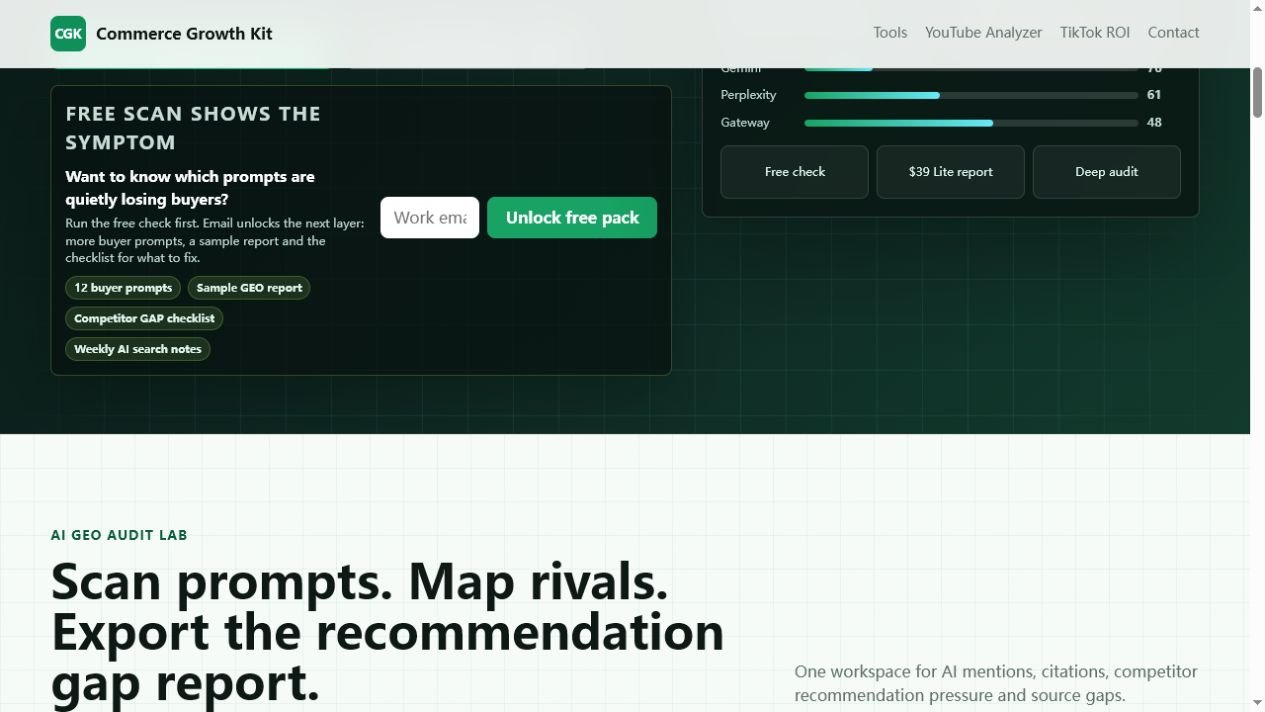
Open the report workflow: Run the AI visibility dashboard demo
A strong dashboard should answer:
- How visible is the brand overall?
- Which AI engines mention it?
- Which competitors have higher share?
- Which prompts are lost?
- Which domains are cited?
- Which domains cite competitors but not us?
- What should we fix in the next 30 days?
That last point matters most.
Brands do not pay for charts. They pay for clarity.
A Practical 30-Day Plan
Week 1: Measure
- Define category
- Choose competitors
- Generate prompts
- Run AI answer checks
- Build the first AI Share of Voice table
Week 2: Fix Website Clarity
- Improve homepage positioning
- Build one category page
- Add FAQ content
- Add use-case sections
- Make product pages easier to cite
Week 3: Build Comparison Assets
- Publish two competitor comparison pages
- Publish one alternatives page
- Add evidence tables and buyer scenarios
Week 4: Build Source Proof
- Pitch reviews
- Add creator demos
- Improve external profiles
- Track cited sources
- Re-run prompts and compare movement
FAQ
Is AI Share of Voice the same as SEO ranking?
No. SEO ranking measures visibility in search results. AI Share of Voice measures visibility inside AI-generated answers.
Which AI engines should I track?
At minimum, track ChatGPT, Perplexity, Gemini, Claude, and Google AI answers where available.
How many prompts should I test?
Start with 8-12 buyer prompts for a small scan. For serious monitoring, expand by category, use case, region, and competitor set.
Can AI Share of Voice change over time?
Yes. AI answers can shift as new content, sources, product pages, reviews, and model behavior change.
Final Checklist
Before you call your brand “AI visible”, check:
- Do you appear in buyer prompts?
- Do you appear across more than one AI engine?
- Does your website get cited?
- Are competitors mentioned more often?
- Which prompts do you lose?
- Which sources does AI trust?
- What should your team fix next?
Start with a free scan:
Measure your AI Share of Voice: https://commercegrowthkit.com/ai-brand-visibility-checker/
Sources
- Ahrefs Brand Radar: https://ahrefs.com/brand-radar
- Ahrefs AI Visibility Metrics: https://help.ahrefs.com/en/articles/15501968-ai-visibility-metrics
- Semrush AI Visibility Toolkit: https://www.semrush.com/kb/1493-ai-visibility-toolkit
- Semrush AI Visibility Data: https://www.semrush.com/kb/1607-semrush-ai-visibility-data
- OtterlyAI Monitoring Interval: https://help.otterly.ai/monitoring-interval
