
Why ChatGPT Recommends Your Competitors But Not Your Brand
Quick Answer
ChatGPT, Perplexity, Gemini, Claude, and Google AI answers usually recommend competitors for one simple reason:
They can find clearer proof for the competitor than they can find for you.
That proof may come from the competitor’s own website, third-party reviews, comparison pages, Reddit discussions, YouTube reviews, marketplace listings, PR mentions, affiliate articles, or trusted industry pages.
If your brand is missing from AI answers, the problem is rarely just "AI does not know us yet." More often, the problem is one of these:
- AI does not understand which category your brand belongs to.
- Your competitors have more visible third-party proof.
- Your website is not cited as a useful source.
- You appear in branded prompts, but not in buyer-intent prompts.
- Your comparison, FAQ, review, and use-case content is too thin.
- Your brand is not connected to enough trusted sources outside your own site.
You can check the problem directly with an AI visibility scan:
Run a free AI Brand Visibility check: CommerceGrowthKit AI Brand Visibility Checker
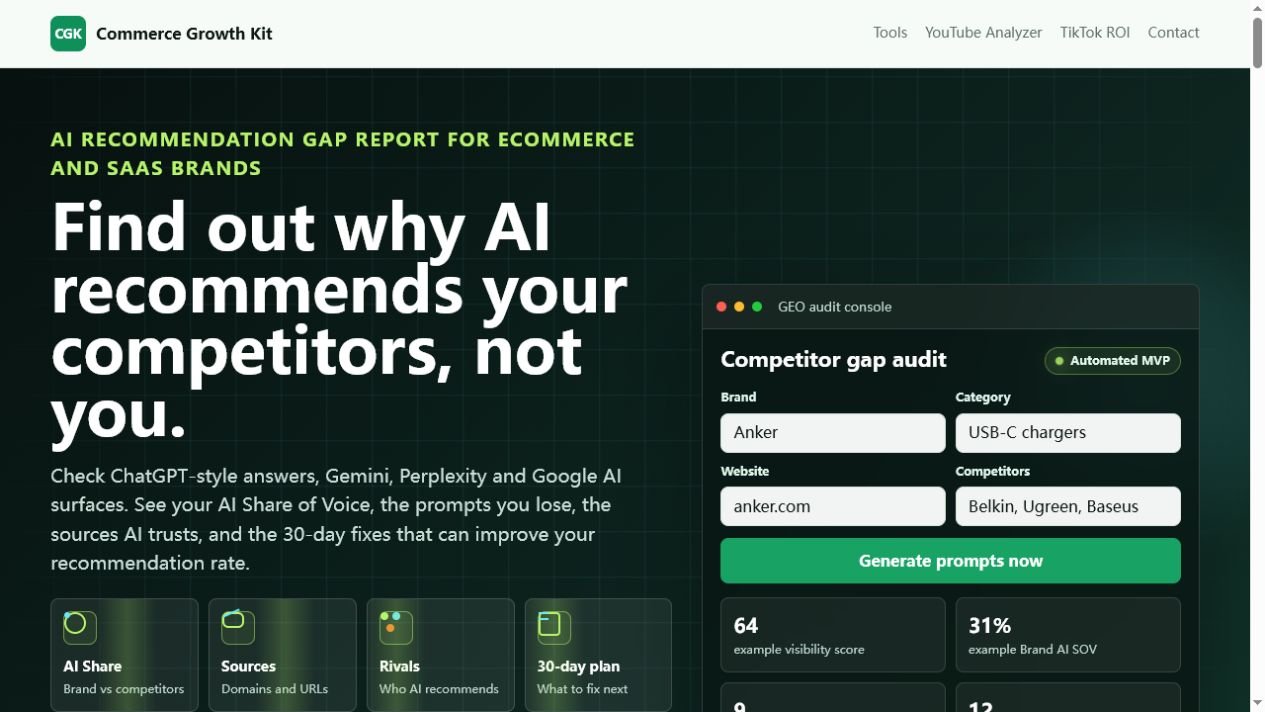
Try the live checker: Run CommerceGrowthKit AI Brand Visibility Checker
The Search Journey Has Changed
A few years ago, a buyer searching for a product might go to Google and type:
- best USB-C hub
- best air purifier for allergies
- best project management software for small agencies
- Anker vs Belkin charger
Today, many buyers ask AI assistants instead:
- What are the best USB-C charger brands for remote workers?
- Which robot vacuum brand should I buy if I have pets?
- Compare Brand A and Brand B. Which one is more reliable?
- What are the best Shopify apps for influencer marketing?
- Which brands are trusted by reviewers and users?
This matters because AI answers often compress the entire buying journey into one response.
Instead of showing ten blue links, the AI may recommend three brands, explain why, and cite a few sources.
If your competitor appears there and you do not, you may lose the buyer before they ever reach Google search results.
That is why AI brand visibility is becoming a real growth metric, not just a new SEO buzzword.
What AI Visibility Actually Means
AI visibility is not just "does ChatGPT know my brand?"
A proper AI visibility check should answer at least five questions:
| Question | Why It Matters |
|---|---|
| Is your brand mentioned? | Shows whether AI recognizes you as a possible answer. |
| Is your website cited? | Shows whether AI trusts your own site as a source. |
| Which competitors appear? | Shows who is winning the AI recommendation layer. |
| Which prompts do you win or lose? | Shows where your brand appears in the buyer journey. |
| Which sources are cited? | Shows what kind of proof AI relies on. |
Tools such as Semrush’s AI Visibility Toolkit and Ahrefs Brand Radar show that the category is moving toward measurable dashboards: mentions, citations, sentiment, AI Share of Voice, source pages, prompt tracking, and competitor benchmarking.
That direction is useful because brands do not just need another "AI SEO" article. They need a report that tells them where they are missing, who is beating them, and what to fix next.
Why Competitors Show Up First
1. Competitors Have More Public Proof
AI systems are trained and supported by large amounts of public information. When an AI assistant recommends a brand, it is often leaning on visible patterns from the web.
Competitors may have:
- More review articles
- More comparison pages
- More YouTube reviews
- More Reddit discussions
- More affiliate roundups
- More marketplace ratings
- More mentions from industry sites
- More clear product category pages
If your brand only talks about itself on its own website, while competitors are discussed across many sources, AI has more confidence recommending them.
Operator note:
This is why a brand’s AI visibility problem is not always solved by publishing more blog posts. Sometimes the real gap is third-party proof.
2. Your Website Does Not Clearly Explain the Category
Many brands write beautiful homepage copy but fail to explain basic category context.
For example, a brand may say:
> "Smarter power for modern life."
That sounds nice, but it may not help AI understand whether the company sells USB-C hubs, fast chargers, power banks, docking stations, or smart home devices.
AI answers tend to perform better when a site clearly explains:
- What the product is
- Who it is for
- Which category it belongs to
- What use cases it solves
- How it compares with alternatives
- What evidence supports the claim
If competitors have clear pages like "Best USB-C chargers for MacBook Pro" or "Portable power bank comparison", they may win category prompts even if your brand is strong offline.
3. You Win Branded Prompts But Lose Buyer Prompts
Many teams test AI visibility the wrong way.
They ask:
- What is Brand X?
- Is Brand X a good company?
- Tell me about Brand X.
These are branded prompts. They are useful, but they do not represent most high-intent discovery moments.
The more important prompts are buyer prompts:
- What are the best brands for [category]?
- Which [category] brand is most reliable?
- Compare [your brand] with [competitor].
- What are the best alternatives to [competitor]?
- Which [category] brand has the best reviews?
- What should I buy if I care about [use case]?
If your brand only appears when the user already knows your name, AI is not helping you acquire new buyers.
The real test:
Can AI recommend your brand before the buyer searches for you by name?
4. AI Cites Other Sources Instead of Your Website
Brand mention and website citation are different things.
AI may mention your brand but cite:
- Amazon
- YouTube
- Wirecutter-style review sites
- G2 or Capterra
- Affiliate blogs
- Competitor comparison pages
- Marketplace category pages
That can be useful, but it also means your own website is not the source of authority.
If AI mentions you without citing your site, your website may need stronger pages:
- Product comparison pages
- Use-case pages
- FAQ pages
- Review summary pages
- Specification pages
- "Best for" landing pages
- Buyer guide pages
This is where AI citation tracking becomes important.
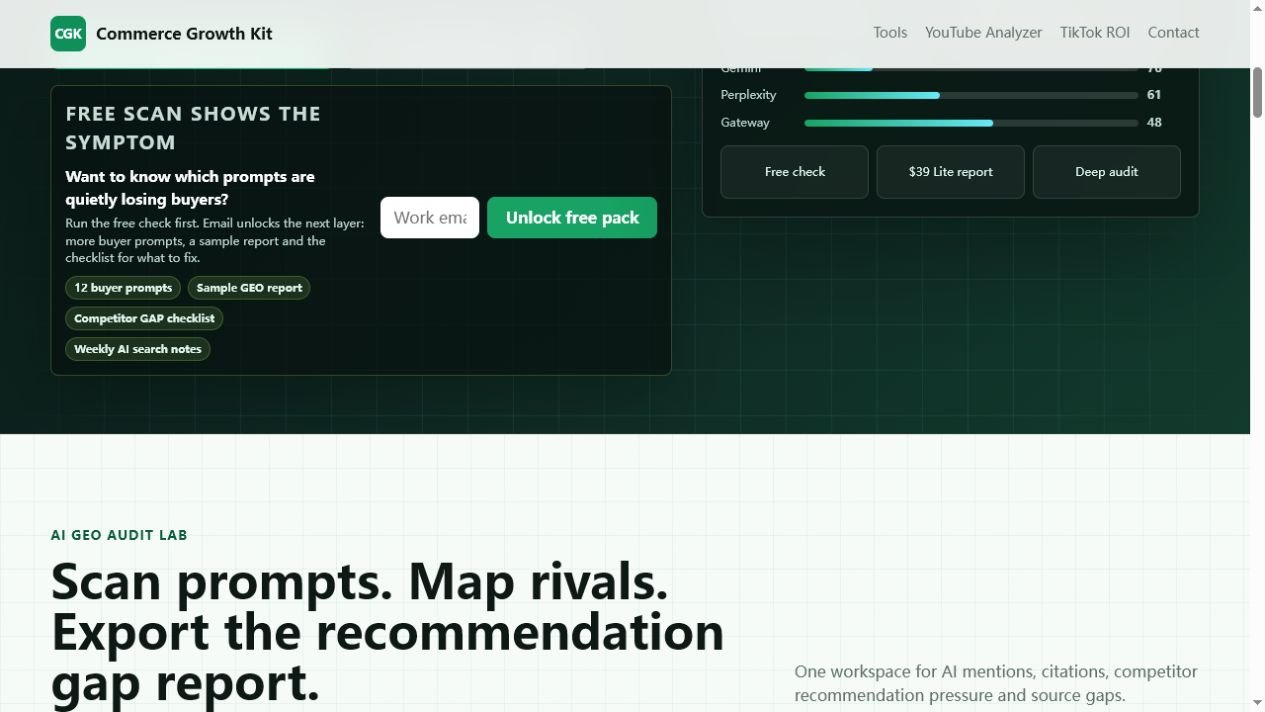
See the report workflow: Open the AI visibility dashboard demo
5. Competitors Own the Comparison Layer
Comparison content is one of the biggest AI visibility gaps.
If users ask:
- Brand A vs Brand B
- Best alternatives to Brand A
- Is Brand A better than Brand B?
- Which brand is better for beginners?
AI needs comparison material.
If competitors, affiliates, reviewers, and forums have already framed the comparison, AI may repeat that structure.
Brands often avoid comparison pages because they feel too direct. But AI answer engines need structured comparison signals.
A useful comparison page should include:
- Who each product is best for
- Feature differences
- Pricing differences
- Use-case differences
- Limitations
- Support/warranty differences
- Third-party review references
- Clear recommendation logic
The goal is not to attack competitors. The goal is to help buyers make a decision.
A Simple AI Visibility Audit Workflow
If you want to diagnose this manually, use this workflow.
Step 1: Define the Category
Write down the product category in plain buyer language.
Bad:
- smart lifestyle solution
- next-generation commerce tool
- premium innovation platform
Better:
- USB-C charger
- smart home security camera
- AI meeting note taker
- Amazon keyword research tool
- Shopify influencer marketing tool
AI visibility starts with category clarity.
Step 2: Choose 3-5 Competitors
Pick competitors that buyers actually compare with you.
Do not only choose your largest enterprise competitor. Include:
- Direct product competitors
- Cheaper alternatives
- Premium alternatives
- Marketplace leaders
- Brands often mentioned by reviewers
Step 3: Generate Buyer Prompts
Create 8-12 prompts across different stages:
| Prompt Type | Example |
|---|---|
| Best brand | What are the best [category] brands for [audience]? |
| Comparison | Compare [brand] with [competitor]. Which is better? |
| Alternative | What are the best alternatives to [competitor]? |
| Trust | Is [brand] a trustworthy [category] brand? |
| Use case | Which [category] is best for [specific need]? |
| Source-seeking | Mention sources or reviews if possible. |
Step 4: Test Across Multiple AI Engines
Do not rely on one model.
Test across:
- ChatGPT
- Perplexity
- Gemini
- Claude
- Google AI Overviews or AI Mode where available
Different engines may cite different sources and recommend different brands.
Step 5: Score Every Answer
For each answer, track:
- Was your brand mentioned?
- Was your website cited?
- Which competitors were mentioned?
- Which competitor appeared first?
- What sources were cited?
- Was the sentiment positive, neutral, or negative?
- Did the answer include buying reasons?
- Did the answer mention your key product category?
This turns AI visibility from a vague feeling into a measurable workflow.
You can automate this workflow here:
Try the AI Brand Visibility Checker: https://commercegrowthkit.com/ai-brand-visibility-checker/
What To Fix First
If AI Does Not Mention Your Brand
Focus on category association.
Create or improve:
- Category landing pages
- "Best for [use case]" pages
- Product schema and structured data
- Clear homepage positioning
- FAQ pages using buyer language
- Third-party profile pages
If AI Mentions You But Does Not Cite Your Website
Focus on source trust.
Improve:
- Product documentation
- Comparison pages
- Buyer guides
- Review summary pages
- Author/about/editorial trust pages
- Crawlability and indexability
If Competitors Dominate Comparison Prompts
Focus on comparison coverage.
Build:
- [Your brand] vs [competitor] pages
- Alternatives to [competitor] pages
- Best [category] for [use case] pages
- Third-party reviews and PR mentions
If AI Cites Reddit, YouTube, or Review Sites
Focus on external proof.
You may need:
- Influencer reviews
- Founder/operator interviews
- Community answers
- Partner pages
- Expert comparison content
- More public product proof
A Practical 30-Day GEO Action Plan
Days 1-3: Measure the Gap
- Run AI visibility checks for your brand and 3-5 competitors.
- Save prompt-level answers.
- Count brand mentions and competitor mentions.
- List cited domains.
- Identify which prompts you lose.
Days 4-10: Fix Category Clarity
- Rewrite unclear homepage/category copy.
- Add one strong category page.
- Add FAQ questions in buyer language.
- Make product use cases explicit.
Days 11-20: Build Comparison Assets
- Publish 2-3 comparison pages.
- Publish one alternatives page.
- Add evidence tables, use cases, limitations, and buyer decision notes.
Days 21-30: Build Source Proof
- Pitch reviews or creator demos.
- Improve product pages that can be cited.
- Add original data, screenshots, examples, and documentation.
- Track whether AI answers begin to mention or cite the brand more often.
The Best AI Visibility Reports Should Show These Metrics
A useful AI visibility report should not stop at "your score is 62."
It should show:
- AI Share of Voice
- Brand mentions
- Competitor mention share
- Website citations
- Cited domains
- Prompt wins and losses
- Model-level differences
- Source gaps
- Content gaps
- Sentiment
- 30-day action plan
- Exportable report for team or client review
That is the difference between a toy checker and a useful GEO workflow.
FAQ
What is AI brand visibility?
AI brand visibility means how often and how positively your brand appears in AI-generated answers across tools such as ChatGPT, Perplexity, Gemini, Claude, and Google AI answers.
What is AI Share of Voice?
AI Share of Voice compares how often your brand appears in AI answers against competitors for a defined set of prompts, topics, or categories.
Why does ChatGPT recommend competitors?
Usually because competitors have clearer public proof, stronger third-party mentions, better comparison content, and more retrievable source material around buyer-intent questions.
Can I improve AI visibility with SEO?
Yes, but not with generic blog posting alone. You need category clarity, crawlable pages, useful comparison content, third-party proof, and source-level credibility.
Should ecommerce brands care about GEO?
Yes. If buyers ask AI assistants for product recommendations, brands need to understand whether they are mentioned, cited, and compared fairly.
Final Checklist
Before you publish another blog post, check whether you know:
- Which buyer prompts matter for your category
- Which AI engines mention your brand
- Which competitors appear more often
- Whether your website is cited
- Which third-party domains AI trusts
- Which comparison prompts you lose
- What page, source, or proof gap should be fixed first
If you do not know these answers yet, start with a visibility scan:
Run the free AI Brand Visibility Checker: https://commercegrowthkit.com/ai-brand-visibility-checker/
Suggested WordPress Images
1. Hero/product intro image:
C:/Users/10032/Documents/Smartwings资源开发/aipilotdaily-article-assets/commercegrowthkit-ai-brand-checker-hero.png
2. Product report/dashboard demo image:
C:/Users/10032/Documents/Smartwings资源开发/aipilotdaily-article-assets/commercegrowthkit-ai-visibility-report-dashboard.png
3. Optional custom graphic to create later:
"AI answer engine flow: buyer prompt -> AI answer -> brand mentions -> cited domains -> competitor share -> action plan."
4. Optional table screenshot:
"Prompt wins/losses matrix with ChatGPT, Perplexity, Gemini, Claude columns."
Sources Used
- Semrush AI Visibility Toolkit: https://www.semrush.com/kb/1493-ai-visibility-toolkit
- Ahrefs Brand Radar: https://ahrefs.com/brand-radar
- Ahrefs AI Visibility Metrics: https://help.ahrefs.com/en/articles/15501968-ai-visibility-metrics
- OtterlyAI Monitoring Interval: https://help.otterly.ai/monitoring-interval


Daniel Cooper
Thông tin hữu ích quá. Letco tự hào là công ty tư vấn du học Hàn Quốc uy tín, cam kết đồng hành đến khi bạn nhập học thành công. Xem thêm tại letco.vn.