TOOL SELECTION GUIDE
Use Cerebro when you have competitor ASINs. Use Magnet when you have a seed keyword. The strongest workflow uses both—but in a defined order, so the output becomes smaller and more useful instead of larger and noisier.
Cerebro vs Magnet at a glance
| Question | Cerebro | Magnet |
|---|---|---|
| Starting input | One or more competitor ASINs | A seed keyword or keyword list |
| Best use | Reverse-ASIN ranking evidence | Keyword expansion and list analysis |
| Primary risk | Choosing unlike competitors | Collecting loosely related phrases |
| Next step | Filter and cluster ranking terms | Validate suggestions against competitors |
What our paid-account case revealed
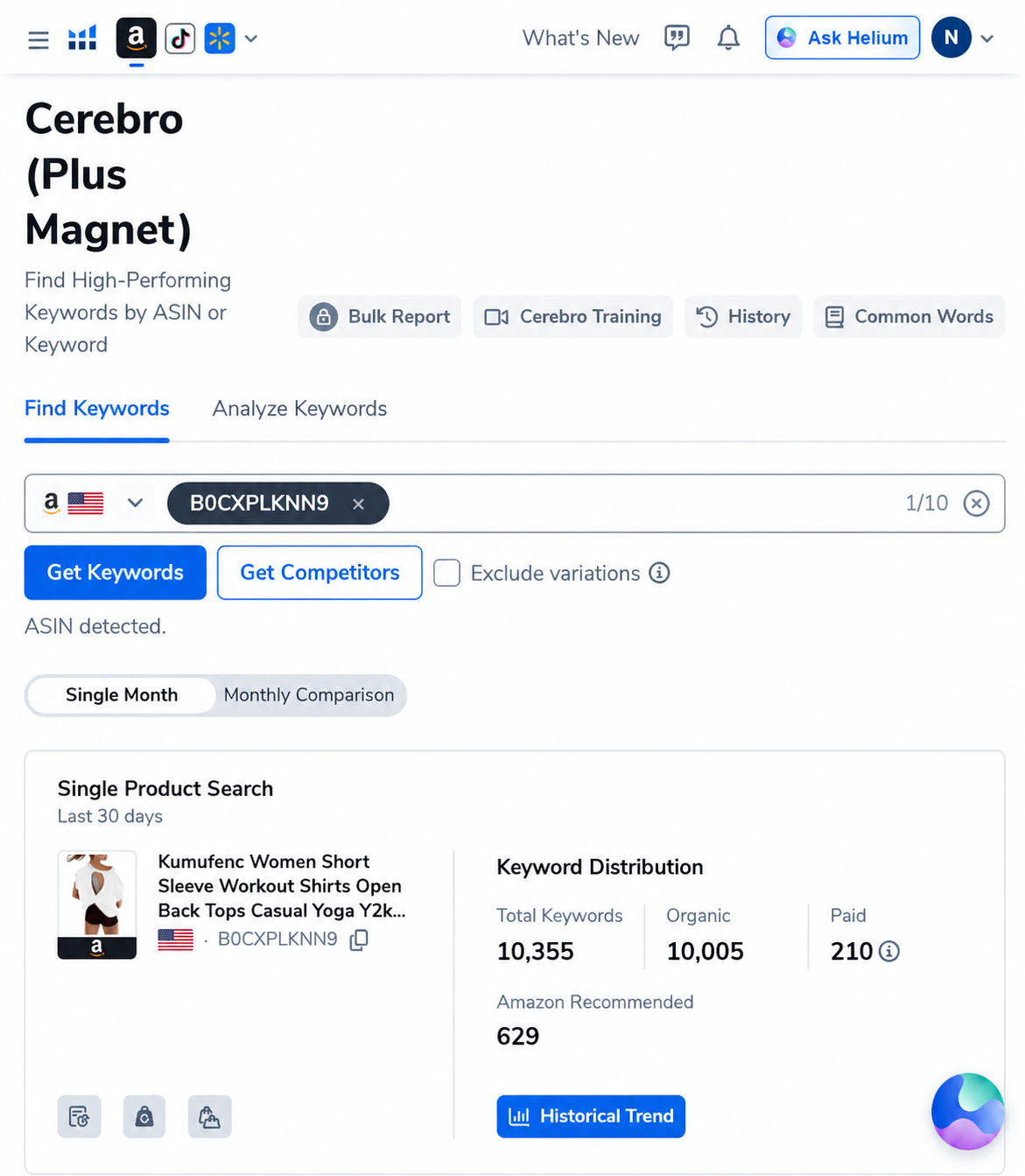
We entered Amazon ASIN B0CXPLKNN9 in Cerebro. The first pass returned 10,355 keywords: 10,005 organic, 210 paid and 629 Amazon-recommended. That scale is useful for discovery but too broad for a listing brief.
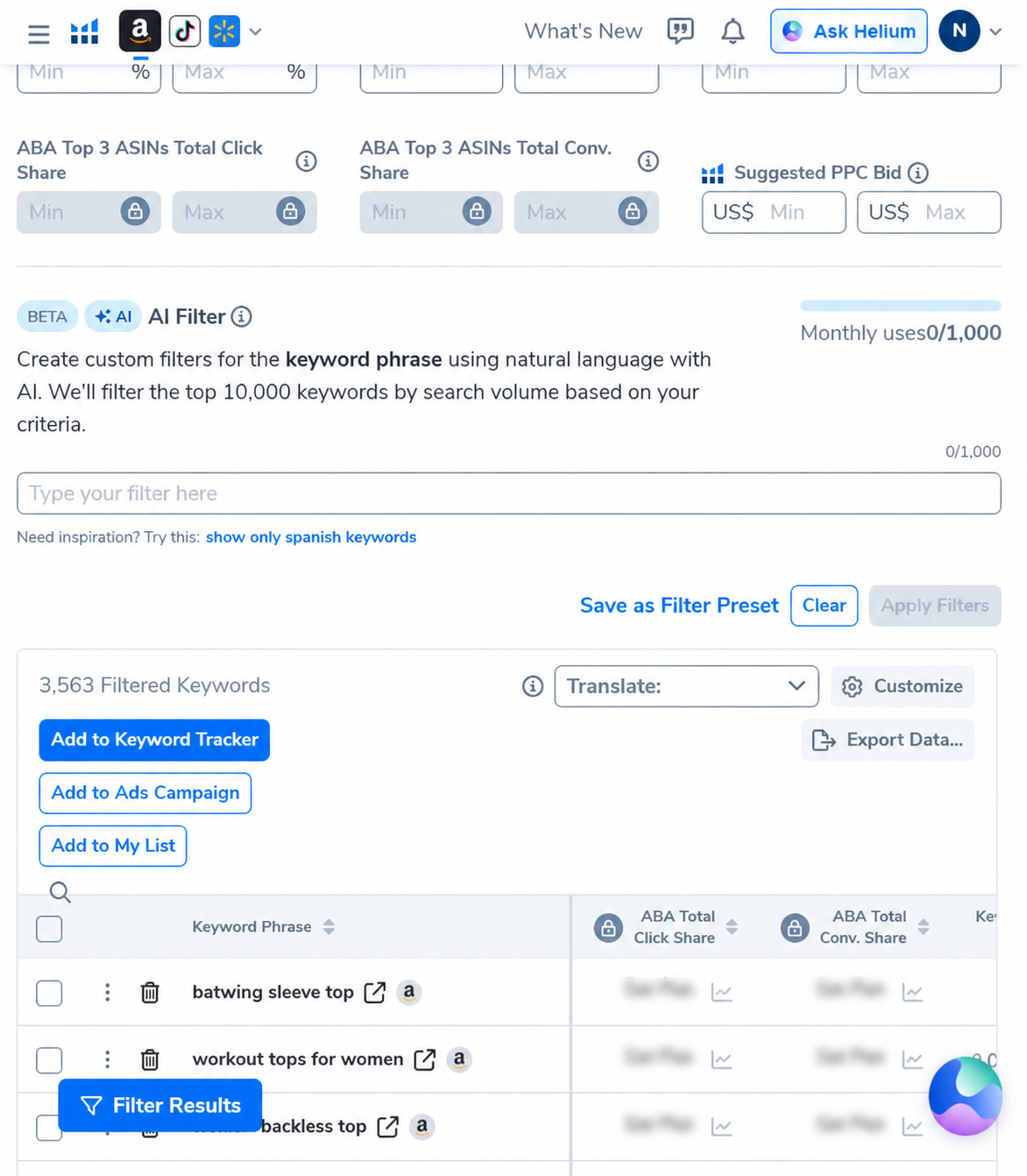
Applying a minimum word count of three and a minimum search volume of 500 reduced the set to 3,563. This 65.6% reduction is the useful lesson: filtering creates the working set; the raw total is only an inventory of possibilities.
Three keyword examples and the trade-off
| Keyword | Search volume | Title density | Organic rank | Interpretation |
|---|---|---|---|---|
| workout tops for women | 134,764 | 8 | 3 | Large demand, broad intent; expensive to treat as the only target. |
| open back workout top | 3,324 | 2 | 1 | Smaller but more product-specific; promising for copy and ads. |
| backless workout tops for women | 1,211 | 1 | 1 | Relevant long tail, but low keyword sales in this snapshot calls for caution. |
The combined workflow
- Run Cerebro on the closest competing ASINs.
- Extract recurring roots and buyer modifiers.
- Send the most relevant roots into Magnet for adjacent phrasing.
- Remove words that misstate material, audience, fit or use.
- Separate listing-indexing terms from PPC experiments.
Current product reality: one workspace, two starting logics
In the 2026 interface, Helium 10 has integrated Magnet into Cerebro. “Cerebro vs Magnet” is therefore most useful as a comparison of research modes, not necessarily two isolated menu items. Reverse-ASIN mode asks what a product ranks for. Seed-keyword mode asks what other phrases relate to an idea. Understanding that difference prevents the interface change from making the workflow confusing.
Choose the starting evidence you actually have
| Your situation | Start here | Reason | Next validation |
|---|---|---|---|
| You know 3–10 close competitor ASINs | Cerebro / reverse-ASIN | Ranking evidence is more concrete than brainstorming | Expand repeated roots with keyword suggestions |
| You have a product idea but weak competitor matches | Magnet / seed-keyword mode | Discover how shoppers describe the idea | Find ranking ASINs and run reverse-ASIN analysis |
| You are writing a listing | Both | Needs competitive evidence and natural language coverage | Assign terms to title, bullets and backend |
| You are building PPC tests | Both | Competitor terms and adjacent phrases create different experiments | Separate exact, phrase and negative lists |
Single-ASIN versus multi-ASIN research
A single-ASIN search is excellent for learning one listing’s footprint, but it can overrepresent that seller’s unusual copy, category placement or advertising history. A multi-ASIN comparison is stronger for identifying shared market language. Choose products with similar form, price band, target customer and use case; otherwise keyword overlap becomes less meaningful.
For a multi-ASIN pass, classify terms into four groups:
- Shared core: several close competitors rank; usually important category vocabulary.
- Feature-specific: only products with a matching attribute rank; use only if your product truly has it.
- Brand leakage: brand or model queries; generally unsuitable for listing copy and may create ad-policy concerns.
- Adjacent intent: related use cases or substitute products; consider for controlled PPC discovery, not primary indexing.
How to interpret the three observed keywords
“workout tops for women”
The 134,764 search-volume snapshot and organic rank 3 show meaningful visibility for the seed ASIN, but the phrase is broad. It can establish category relevance, yet it does not communicate the open-back differentiator. Treat it as a broad benchmark and monitor whether it converts profitably.
“open back workout top”
At 3,324 search volume, title density 2 and organic rank 1 in our snapshot, this phrase is much closer to the product’s visible feature. It deserves consideration for prominent copy, provided the garment is accurately described as open back.
“backless workout tops for women”
The phrase showed 1,211 search volume, title density 1 and organic rank 1, but only one keyword sale in the captured table. That conflict is exactly why no single metric should make the decision. Keep it as a relevant secondary phrase or test, then measure actual conversion.
A scoring model for prioritization
Instead of a proprietary-looking “opportunity score,” use a transparent editorial score. Rate each phrase from 0–2 on literal relevance, buyer specificity, competitor evidence and placement fit. Demand can break ties but should not rescue an inaccurate term. Record why a score was assigned so another editor can reproduce the decision.
| Criterion | 0 points | 1 point | 2 points |
|---|---|---|---|
| Literal relevance | Wrong product/feature | Related but incomplete | Accurately describes product |
| Buyer specificity | Ambiguous browsing | Category intent | Clear product/use intent |
| Competitor evidence | No close match ranks | One close match | Several close matches |
| Placement fit | Would sound misleading | Natural in supporting copy | Natural in prominent copy |
Operational checklist
- Lock marketplace, date and product scope before comparing metrics.
- Save the original result count before filtering.
- Document every threshold so the query is reproducible.
- Read at least the top relevant listing pages; do not rely only on summary rows.
- Keep brand terms, generic terms and feature terms in separate clusters.
- Export only after manual exclusions and job assignment.
- Re-run the research after material seasonality or category changes.
Example output: a one-page keyword decision brief
The final deliverable should fit on one page before anyone writes copy. Begin with the primary customer and product promise. Add three to five core roots, five to fifteen supporting feature/use phrases and a clearly separated PPC experiment list. Include rejected phrases with short reasons; this prevents them from being reintroduced during later revisions.
For the open-back workout-top example, a sensible hierarchy would keep the broad category phrase for context, elevate an accurate open-back phrase for differentiation and reserve more ambiguous backless variants for testing. The hierarchy is more valuable than a spreadsheet sorted by volume because it explains how each phrase contributes to the offer.
Frequently asked questions
Can Cerebro replace Magnet after the integration?
The current combined workspace supports both reverse-ASIN and seed-keyword research logic. The important distinction is still the starting input and the question being answered, not whether two separate navigation items appear.
How many competitor ASINs should I use?
Start with a small set of genuinely comparable listings. Three to ten is usually easier to audit than a broad mixed set. Similarity matters more than count.
Which tool should a beginner use first?
If the beginner can identify close competitors, reverse-ASIN evidence usually provides a more grounded starting point. If the product idea is new or hard to match, begin with seed phrases and then locate comparable ASINs.
Does organic rank prove a keyword converts?
No. Rank indicates visibility in the captured dataset. It does not reveal your future conversion rate, margin or advertising efficiency.
AI PILOT DAILY EXCLUSIVE
Use the right keyword tool, then verify the final list
AIPILOTDAILY20 20% off the first 6 months of an eligible monthly subscription.
AIPILOTDAILY10 10% off eligible monthly billing on an ongoing basis.
Affiliate disclosure: we may earn a commission if you purchase through this link, at no extra cost to you. Verify plan eligibility and the final price at checkout.
Methodology
We used a paid account and a real Amazon ASIN on September 5, 2026. Figures are a dated research snapshot, not guaranteed performance. Tool definitions were checked against Helium 10’s official knowledge base.
Keyword clustering: Use Cerebro Word Frequency to organize recurring product language.