PAID-ACCOUNT FILTER CASE STUDY
Cerebro has enough filters to make almost any export look precise. The hard part is applying them in an order that preserves buyer relevance instead of merely shrinking the row count.

The starting point: 10,355 keyword records
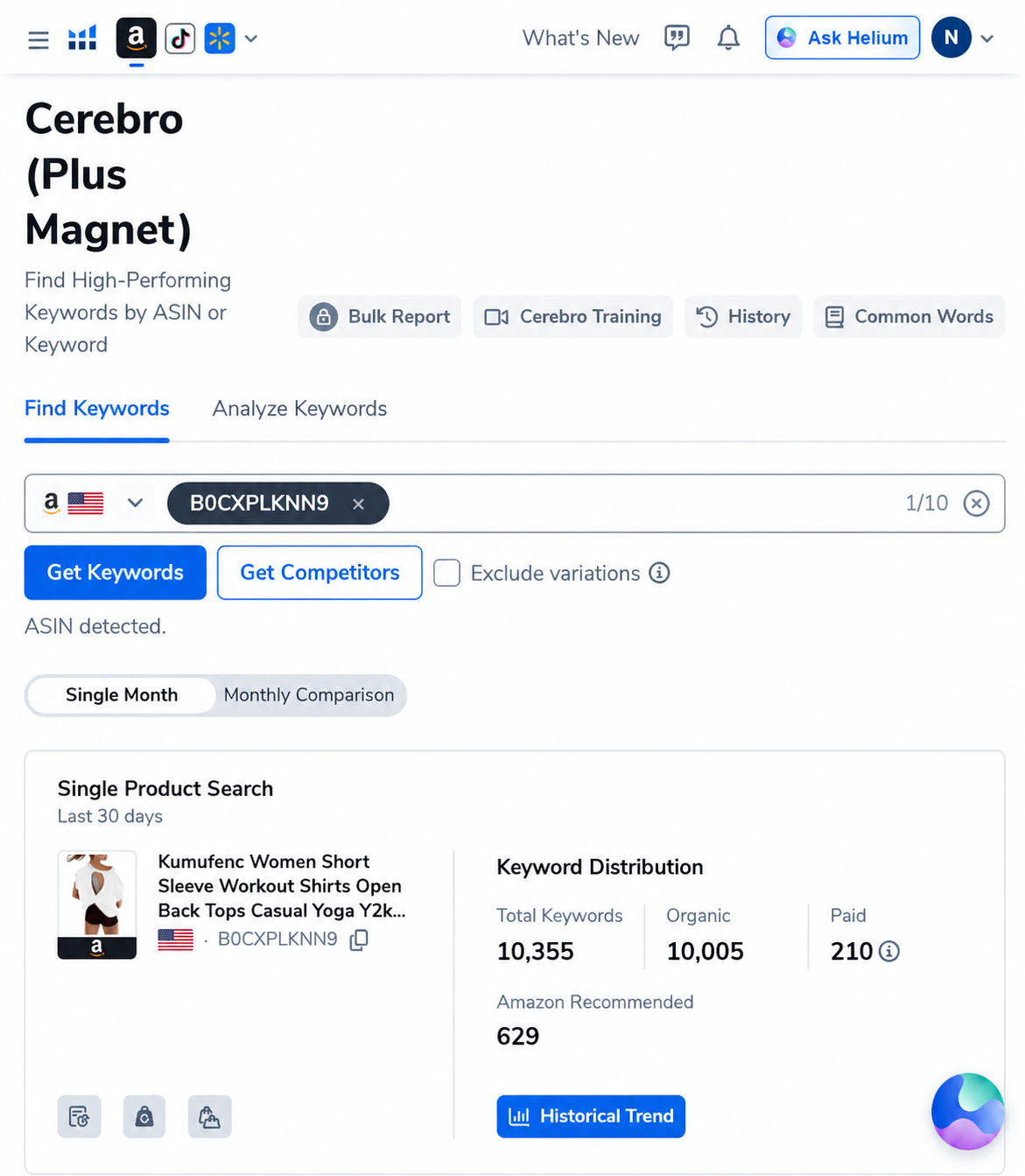
We ran one women’s open-back workout-top ASIN in a paid Helium 10 account in September 2026. Cerebro displayed 10,355 total keyword records, including 10,005 organic, 210 sponsored and 629 Amazon-recommended signals. Those categories overlap, so their figures should not be treated as separate totals.
There is no universal best filter preset
The “best” filters depend on the decision. A listing brief needs strict literal relevance. A PPC discovery campaign may tolerate broader language. Product research needs enough vocabulary to expose market segments. Applying one preset to all three jobs creates false precision.
| Research job | Start strict on | Keep flexible on |
|---|---|---|
| Listing copy | Product relevance, audience, feature accuracy | Search-volume threshold for valuable long tails |
| Exact-match PPC | Commercial intent, relevance, acceptable test economics | Current organic rank |
| Phrase/broad discovery | Negative themes and product mismatch | Word count and adjacent modifiers |
| Competitor research | Comparable ASIN selection | Rank range until patterns appear |
The filter order we recommend
1. Clean the product set before touching numeric filters
If the seed or competitor ASINs include different products, every later filter inherits the mistake. Check product type, audience, material, format, price band and variation structure. Run separate sets for meaningful segments instead of mixing them.
2. Apply a literal relevance screen
Remove phrases that describe the wrong garment, audience, material or use case. This is a human editorial step. No search-volume or IQ threshold can make an inaccurate phrase suitable for a listing.
3. Use word count to expose intent
A minimum word count can surface more specific queries, but longer is not automatically better. Three-word phrases often reveal features and use cases; they can also contain irrelevant modifiers. Read complete queries rather than assuming every long tail converts.
4. Add a practical search-volume floor
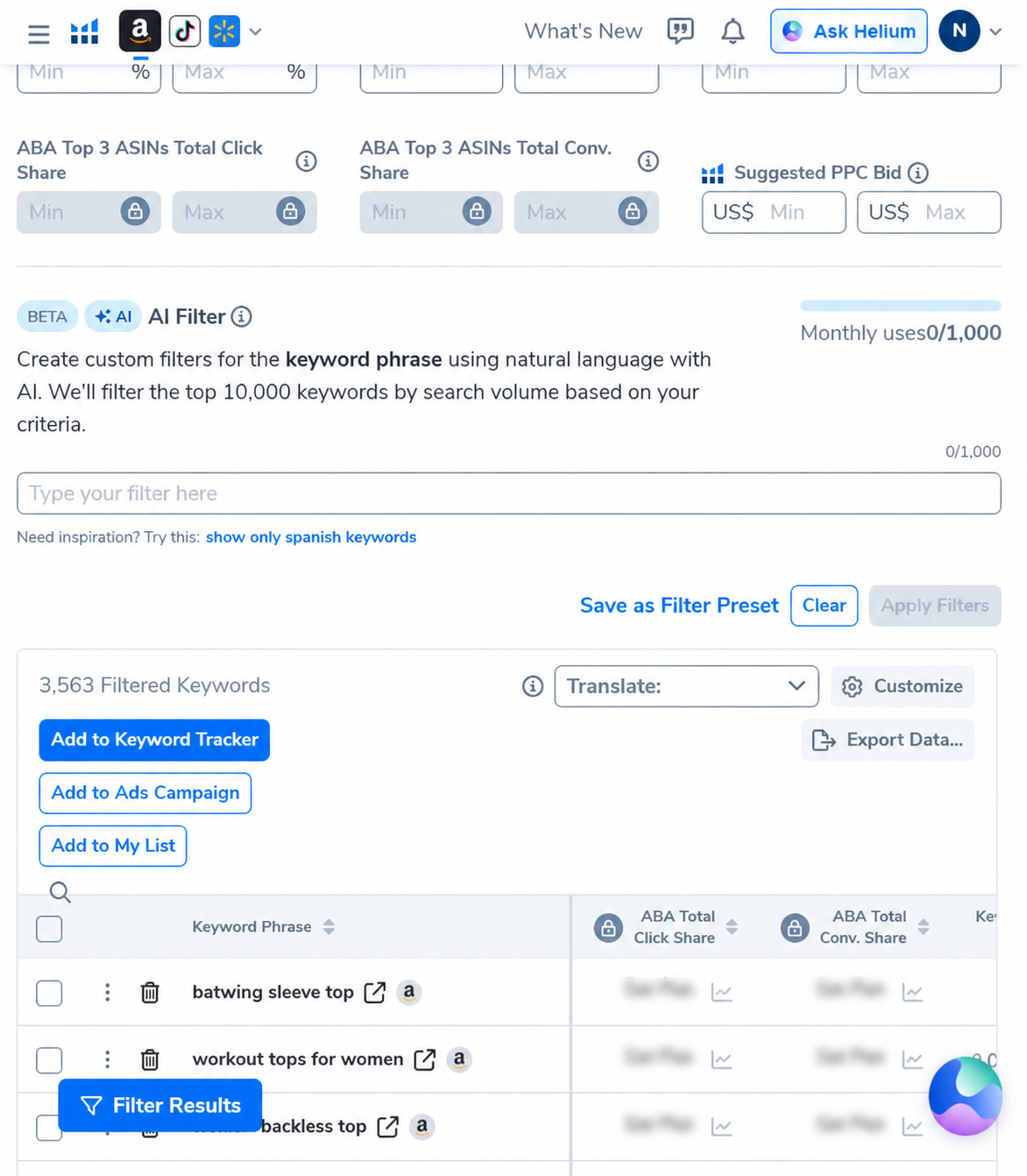
Use the threshold to control workload, not to define demand universally. In our case, a three-word minimum plus a 500 search-volume floor reduced 10,355 records to 3,563—a 65.6% reduction.
5. Layer competitor-rank evidence
For multi-ASIN research, look for keywords where several close competitors rank. This can identify category language, but rank does not prove that the phrase caused sales. Inspect organic and sponsored evidence separately.
6. Add the metric that matches the action
Use organic-rank fields for listing and visibility analysis, sponsored fields for PPC hypotheses, and IQ Score for demand-to-competition prioritization. Avoid stacking every filter simply because the interface allows it.
A reusable Cerebro filter worksheet
| Step | Field or decision | Record before continuing |
|---|---|---|
| 1 | Marketplace and research date | The exact environment behind the estimates |
| 2 | Seed and competitor ASINs | Why each product belongs in the set |
| 3 | Unfiltered keyword count | Baseline for judging filter impact |
| 4 | Excluded themes | Wrong product, audience, material and brands |
| 5 | Word-count rule | Reason it matches the intended job |
| 6 | Search-volume floor | Why lower-volume terms are or are not retained |
| 7 | Rank or match-type filters | Whether the list serves organic, PPC or discovery work |
| 8 | Final clusters and destinations | Title, bullets, backend, exact PPC, discovery or negative |
Use word frequency as a diagnostic
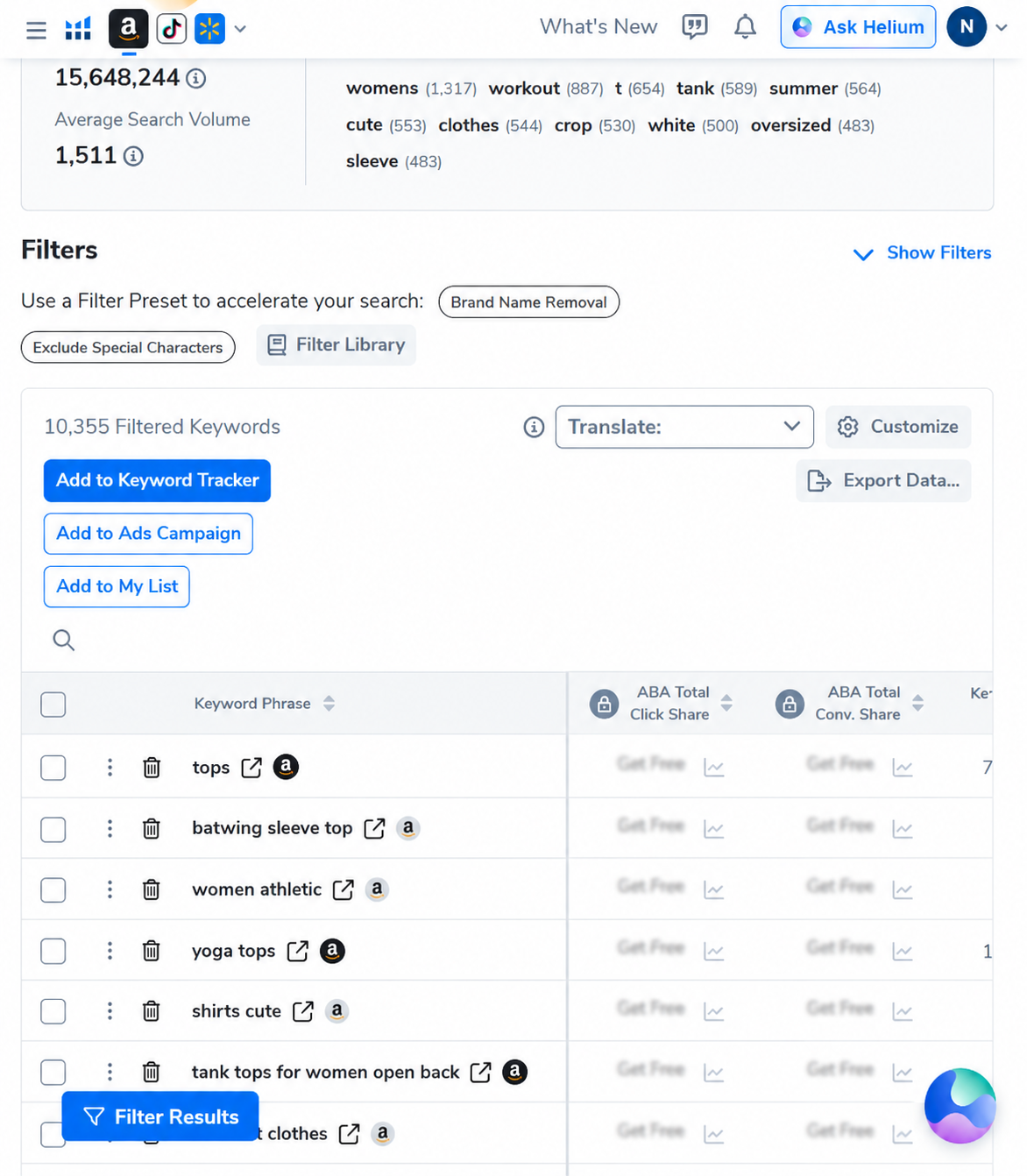
Word frequency reveals repeated vocabulary across the result set. Use it to identify feature, audience and use-case clusters—and to catch irrelevant ASINs. If an added competitor suddenly introduces unrelated product nouns, review the ASIN set before tightening numeric filters.
Filter recipes by objective
Listing-copy shortlist
- Direct competitors only.
- Remove branded and inaccurate phrases.
- Cluster synonyms and feature modifiers.
- Retain terms that can be used naturally and truthfully.
- Assign each cluster to one listing field.
Exact-match PPC test list
- Start with high product relevance.
- Identify commercially specific phrases.
- Review competitor sponsored activity without assuming profitability.
- Estimate the click budget your margin can support.
- Launch a bounded test with clear stop conditions.
Opportunity research list
- Use several close competitor ASINs.
- Apply an evidence-based volume floor.
- Inspect competitor rank distribution.
- Use IQ Score to prioritize review, not declare winners.
- Validate live Amazon results and trend history.
Why the 65.6% reduction is not the result
Reducing 10,355 records to 3,563 made the analysis manageable, but the business output is a short keyword brief with assigned jobs and documented assumptions. A smaller export can still be poor if it contains inaccurate phrases. A larger export can still be useful if it is organized for discovery rather than copied into a listing.
Common filter mistakes
- Applying search volume before removing wrong-product phrases.
- Using an arbitrary minimum because another seller shared a preset.
- Assuming a long-tail query is automatically low competition.
- Mixing organic listing terms and PPC experiments in one final list.
- Treating Cerebro IQ Score as ranking probability.
- Ignoring seasonality and the research date.
- Forgetting that sponsored visibility does not reveal competitor profit.
- Keeping thousands of rows without assigning a destination.
AI PILOT DAILY EXCLUSIVE
Build and filter your own Cerebro dataset
AIPILOTDAILY20 20% off the first 6 months of eligible monthly billing.
AIPILOTDAILY10 10% off eligible monthly billing on an ongoing basis.
View Helium 10 plans and apply a code →
Affiliate disclosure: we may earn a commission if you purchase through this link, at no extra cost to you. Confirm eligibility, duration and final pricing at checkout.
Frequently asked questions
What are the best Helium 10 Cerebro filters?
There is no universal preset. Clean the ASIN set and remove product mismatches first, then layer word count, search volume and competitor-rank fields according to whether the list is for listing copy, PPC or market research.
What minimum search volume should I use?
Use a threshold appropriate to the category and research job. Our 500-volume floor controlled workload in one apparel case; it is not a universal recommendation.
Should I filter by Cerebro IQ Score?
Use IQ Score to prioritize review after relevance filtering. A high score does not prove that a keyword fits the product, converts or is easy to rank for.
How many keywords should remain after filtering?
There is no ideal count. Stop when the relevant clusters have assigned jobs and the remaining uncertainty requires a live listing or advertising test rather than another export.
Keyword clustering: Use Cerebro Word Frequency to organize recurring product language.
Sources and methodology
The screenshots and counts come from a paid Helium 10 account run in September 2026. Filter behavior was cross-checked against Helium 10’s official Cerebro tutorial, its Cerebro filter explanation, and its opportunity-keyword workflow. Results and interface fields vary by marketplace, ASIN, account and date.