AI PILOT DAILY · PRACTICAL GUIDE · NOVEMBER 12, 2026
Use your own cost difference per usable label, then divide the extra equipment cost by that difference. Separate cash savings from unmeasured convenience. Low order volume can make a new printer unnecessary.

Count usable labels, not labels purchased
Start with what your current method costs for a label you actually ship. Include the relevant materials and account for waste. A cheap pack that produces frequent misprints can have a higher usable-label cost than its unit price suggests.
Then estimate the new setup’s material cost using the same definition. Avoid comparing a complete current cost with only the replacement setup’s cheapest consumable.
A hypothetical example
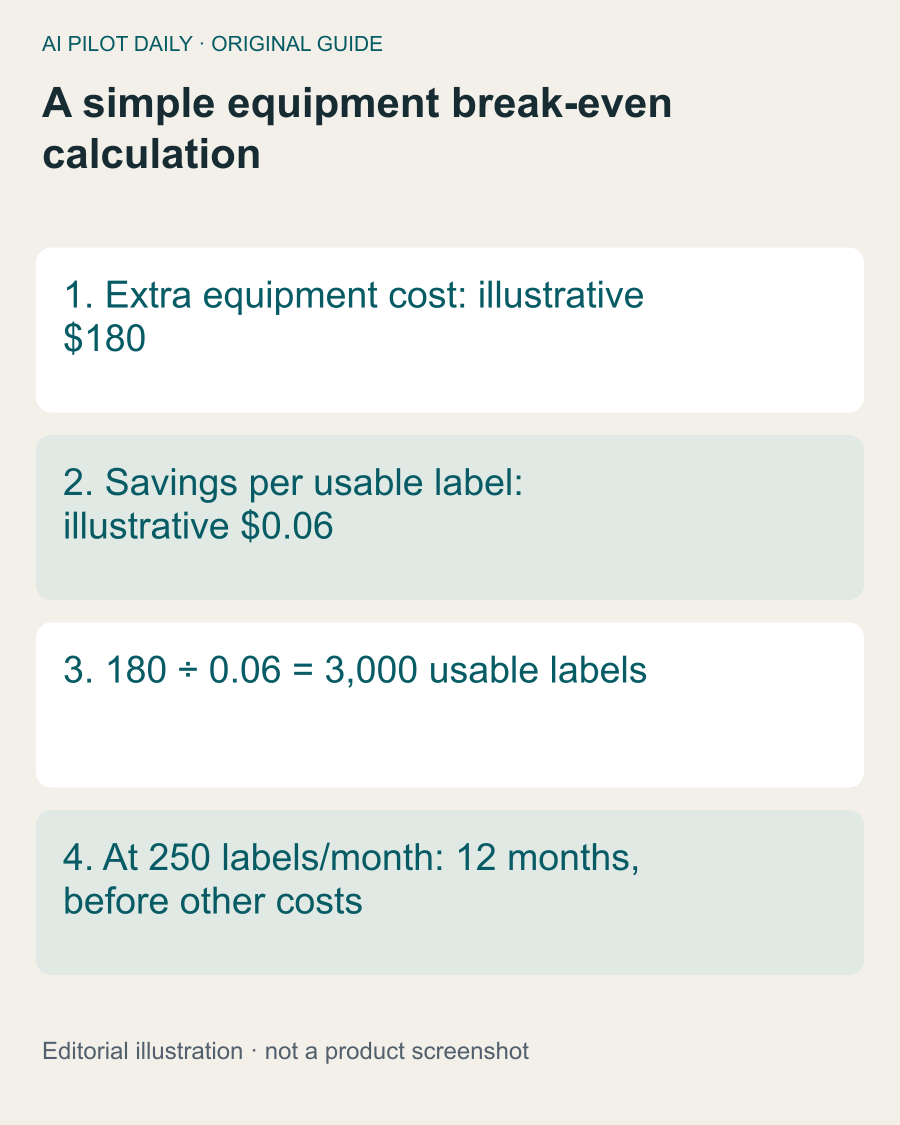
Suppose the additional equipment costs $180 and the new workflow saves six cents per usable label. The simple break-even volume is 180 ÷ 0.06 = 3,000 labels. At 250 labels each month, that is 12 months. At 50 per month, it is 60 months.
These are illustrative inputs, not current printer prices or promised savings. The calculation excludes repairs, financing and other costs you may need to include. If the per-label saving is zero or negative, the equipment does not pay back through material savings under those assumptions.
Do not turn every second into cash
A faster workflow may be valuable, but estimated seconds saved are not automatically money in your bank account. Measure a representative batch, including setup and reprints, before assigning a time benefit.
Keep the time observation separate from the cash-cost calculation. If faster packing helps you meet a cutoff or handle a real workload constraint, explain that operational benefit directly rather than hiding it in an optimistic return-on-investment number.
Use a range for volume
Calculate at a quiet-month volume and a busy-month volume. A business with seasonal spikes should not assume the busiest week repeats all year. Use completed order records when available instead of a sales target.
Also consider whether the existing printer is still needed for other documents. Buying a label printer does not necessarily eliminate the current equipment or its costs.
Buy for the bottleneck you have
If labels are a small part of your packing time, fixing inventory location or order matching may help more. If cutting and taping labels is repeatedly slowing a proven order flow, a dedicated printer becomes easier to justify.
Before buying, verify media compatibility, connection requirements and the actual output from your platform. A low running cost is irrelevant if the printer cannot serve your setup.
The result should be a decision with explicit assumptions. You may conclude that the upgrade makes sense now, later or not at all. All three are better than treating a sale price as proof of payback.
A common question
What if there is no per-label saving?
Then the printer has no material-cost payback under those assumptions; evaluate any other benefit separately.