PRODUCT RESEARCH WORKFLOW
Black Box and Xray answer different questions. Black Box searches Helium 10’s product database using filters; Xray analyzes the products visible on Amazon search, bestseller and product pages. Use Black Box to discover candidates and Xray to challenge them in their live competitive context.
Black Box vs Xray
| Dimension | Black Box | Xray |
|---|---|---|
| Where it runs | Helium 10 web app | Chrome extension on Amazon/Walmart |
| Starting point | Filters, keywords, niche or competitor | Live search results, bestseller page or product page |
| Best question | “What candidates fit my constraints?” | “What does this current result page look like?” |
| Typical output | Broad candidate set | Page-level products and top-line niche metrics |
Real Black Box case: from one ASIN to 194 candidates
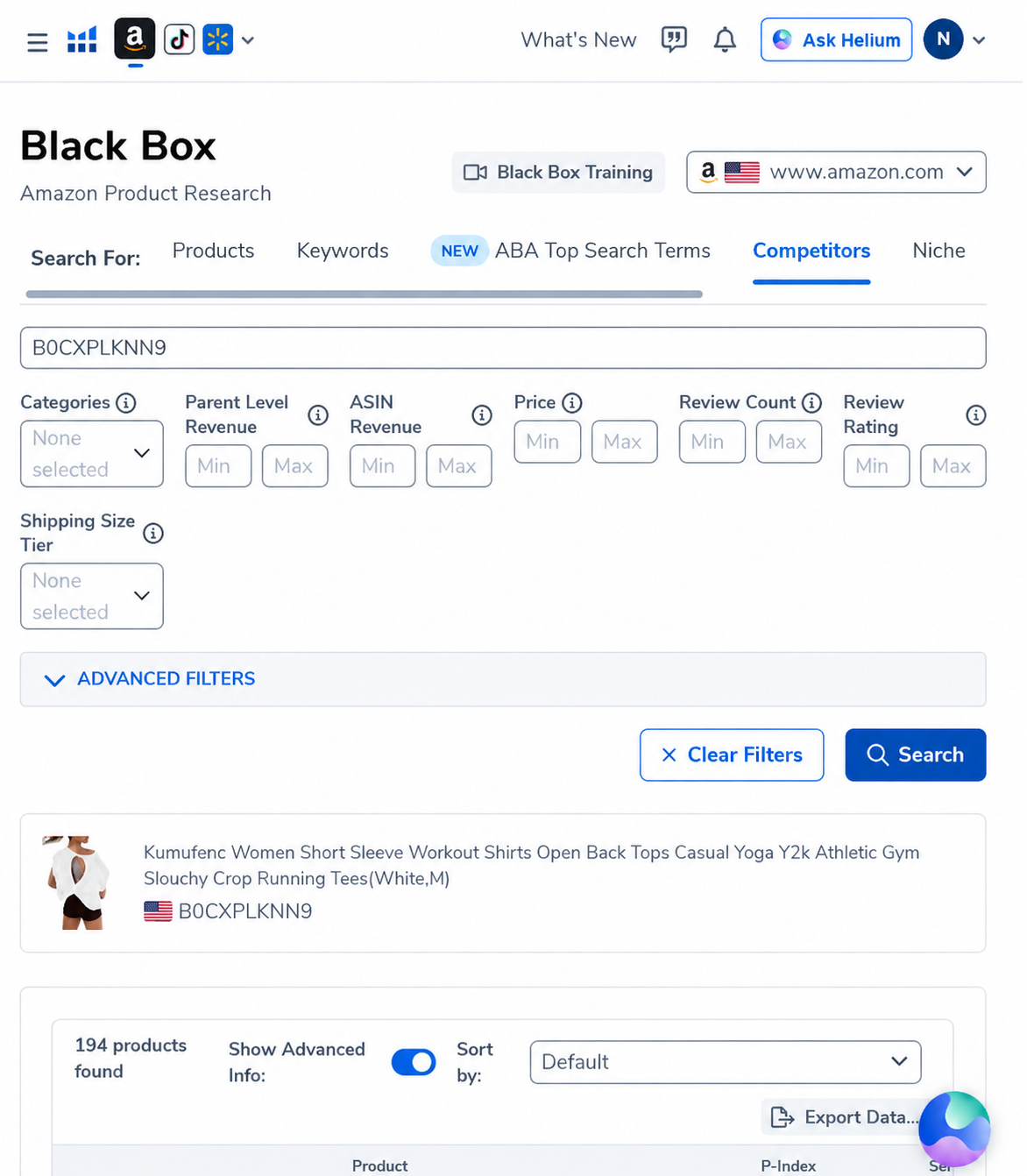
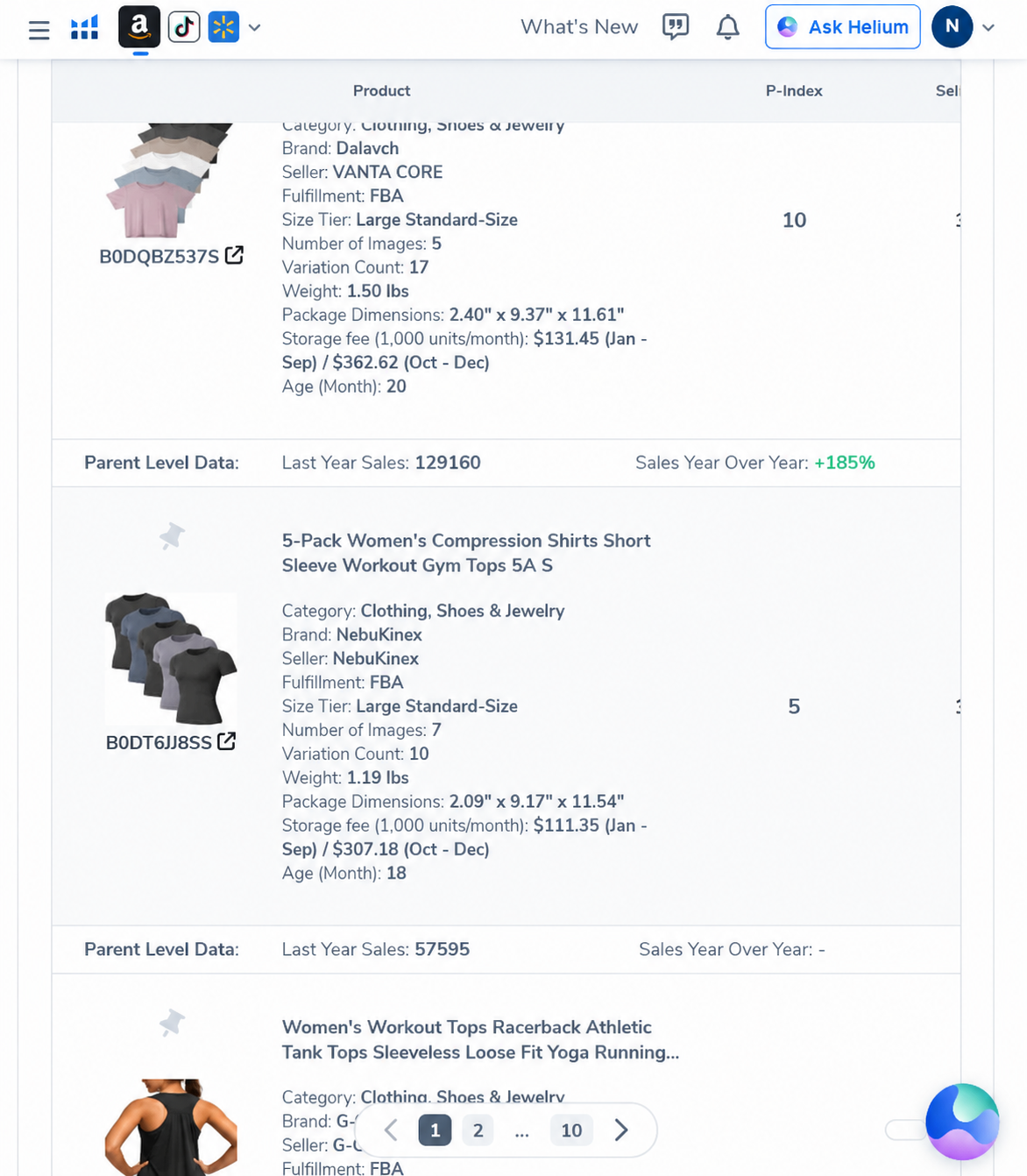
We entered B0CXPLKNN9 in Black Box’s Competitors search. The tool returned 194 related products. That count is useful for mapping the landscape, but it does not mean 194 viable products.
What Xray should verify next
Helium 10’s current Xray documentation says the extension can show search volume, total and average revenue, average price, BSR, reviews and product-level data for the visible result set. Its figures are estimates; variation listings deserve special caution because Amazon exposes ranking at listing level, not clean sales by every color or size.
- Search Amazon using the most product-specific phrase from the Black Box shortlist.
- Open Xray on the result page and remove clearly irrelevant listings.
- Compare the distribution—not only averages—of price, reviews, revenue and BSR.
- Open the strongest and weakest listings to check variations and positioning.
- Run the surviving ASINs in Cerebro to inspect keyword overlap.
A decision gate before sourcing
| Gate | Evidence required |
|---|---|
| Demand | Several relevant listings with consistent recent activity, not one outlier |
| Competition | A plausible path to differentiation beyond price |
| Economics | Supplier quote, landed cost, fees, returns and ad allowance |
| Search fit | Keywords accurately describing the planned product |
Why the 194-result Black Box list is only a starting point
A competitor query can reveal the breadth around an ASIN, but related does not mean substitutable. The 194 results in our paid-account capture may include different cuts, audiences, price points, fulfillment economics and variation structures. Before opening Xray, remove products that fail the same-customer and same-job test.
Build a reproducible Black Box shortlist
- Record the seed: ASIN, marketplace, date and why it is comparable.
- Preserve the unfiltered count: this shows how much the next decisions narrow the field.
- Apply one filter family at a time: category/relevance, then price, demand, reviews and physical constraints.
- Inspect outliers: unusually high revenue, low reviews or low price can be data issues, variation effects or a genuinely different offer.
- Save a small candidate set: five to fifteen products is usually easier to validate carefully than a large export.
| Filter family | Why it matters | Failure mode |
|---|---|---|
| Price range | Sets room for landed cost, fees and ads | Comparing premium and commodity offers together |
| Monthly sales/revenue estimates | Provides a demand screen | Treating an estimate as audited performance |
| Review count/rating | Shows social-proof environment | Assuming low reviews automatically means low competition |
| Size/weight | Affects fulfillment and sourcing economics | Ignoring dimensional-weight changes |
| Seller/fulfillment | Clarifies marketplace structure | Mixing business models with different economics |
Run Xray as a falsification step
The purpose of Xray is not to confirm that a favorite idea is good. Use it to find reasons the Black Box candidate may fail. Search the most relevant buyer phrase on Amazon, run Xray, remove unrelated listings and examine the remaining distribution. If demand depends on one dominant ASIN, if review barriers are concentrated at the top, or if the price band cannot support expected costs, the candidate needs more work.
Read distributions, not only averages
Average revenue can be inflated by a single leader. Average reviews can hide a result page split between entrenched brands and weak listings. Record the median where possible, inspect the top ten individually and note how much of the total appears concentrated in the leading products.
Handle variations carefully
Helium 10’s official documentation warns that Amazon exposes BSR and estimated sales at listing or parent level in ways that make individual variation revenue difficult to interpret. For apparel and other variation-heavy categories, do not assume every color or size shares the displayed performance evenly.
Example decision log for the workout-top seed
| Question | Current evidence | Status |
|---|---|---|
| Are there related products? | Black Box returned 194 candidates | Yes, but relevance filtering required |
| Is buyer language visible? | Cerebro found broad and open-back keyword clusters | Partially validated |
| Is live niche demand distributed? | No Xray result-page capture in this case yet | Unverified |
| Can the economics work? | No supplier quote, landed cost or return-rate input | Unverified |
| Should we source now? | Critical evidence still missing | No |
Complete validation checklist
- Search-volume history rather than a single snapshot.
- Revenue and review concentration across relevant listings.
- Variation structure and parent-child ASIN effects.
- Current price distribution and couponing behavior.
- Estimated FBA fees checked against dimensions and weight.
- Supplier quotes, freight, duties, packaging and inspection.
- Return risk, product compliance and IP review.
- PPC allowance and break-even conversion assumptions.
- Cerebro overlap for three to ten closest ASINs.
- A written differentiation hypothesis that is not merely “cheaper.”
When Black Box or Xray should come first
Start with Black Box when you have constraints but no clear niche: price, category, size, review ceiling or revenue range. Start with Xray when a live Amazon result page, bestseller list or specific product already caught your attention. In both cases, pass the shortlist to the other tool before making a sourcing decision.
A simple economics stress test
Before a candidate earns a “go,” model at least three scenarios. The base case uses realistic selling price, landed cost, current fulfillment fees, expected ad cost and return allowance. The downside case lowers price and conversion while increasing CPC or returns. The upside case can improve those assumptions, but it should not be the only profitable version. Record the assumptions beside the date because Amazon fees and competitive pricing change.
| Scenario | Price | Demand | Ad/return pressure | Required outcome |
|---|---|---|---|---|
| Downside | Below current median | Lower than estimate | Higher | Loss is affordable and bounded |
| Base | Defensible current price | Conservative share | Realistic | Positive contribution margin |
| Upside | Supported by differentiation | Stronger share | Improves with reviews | Attractive, but not required for survival |
Frequently asked questions
Is Black Box data enough to choose a product?
No. It is a discovery and screening tool. Live result-page structure, keyword evidence, supplier economics, compliance and differentiation still need validation.
Is Xray revenue exact?
No. Helium 10 presents estimates derived from marketplace signals. Treat them as comparative research inputs, not audited seller revenue.
Why can variation listings distort analysis?
Amazon often exposes ranking and sales signals at parent-listing level. Assigning that performance cleanly to each color or size is not possible from public data alone.
What should I export from Xray?
Export the filtered, relevant result set together with the search phrase, marketplace, date and excluded-product logic. A CSV without that context is difficult to reproduce.
AI PILOT DAILY EXCLUSIVE
Run discovery and live-page validation in one workflow
AIPILOTDAILY20 20% off the first 6 months of an eligible monthly subscription.
AIPILOTDAILY10 10% off eligible monthly billing on an ongoing basis.
Affiliate disclosure: we may earn a commission if you purchase through this link, at no extra cost to you. Verify plan eligibility and the final price at checkout.
Sources and limitations
Black Box screenshots are from our paid account on September 5, 2026. Xray behavior was checked against Helium 10’s official Xray guide and its variation-data warning. We did not present estimates as audited sales.