AI PILOT DAILY · PRACTICAL GUIDE · NOVEMBER 12, 2026
When speaker labels are wrong, correct the passages that matter using the recording and meeting context. Leave uncertain attribution unresolved rather than assigning a plausible name.

Do not start with a global rename
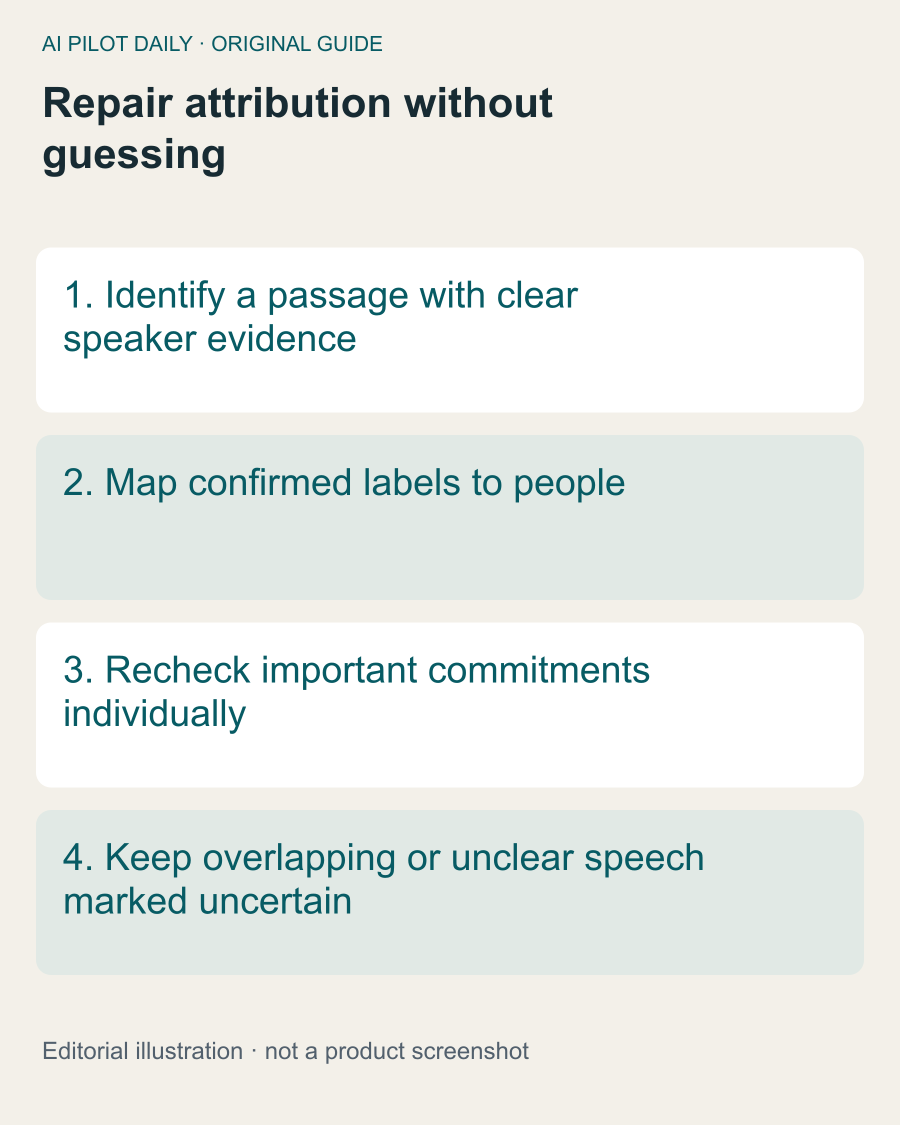
If a transcript labels everyone “Speaker 1” and “Speaker 2,” it is tempting to rename those labels immediately. First confirm that the labeling is consistent throughout the recording. A single mistaken switch can attribute a later promise to the wrong person.
Find a clear passage where a person identifies themselves or where the context reliably establishes the speaker. Use it as a reference, not as proof that every similar-sounding segment belongs to them.
Prioritize consequential statements
Check ownership of decisions, requests, commitments and sensitive opinions before polishing less important dialogue. A harmless joke assigned to the wrong person is different from an approval or deadline being misattributed.
Keep a short correction log with the timestamp, original label, corrected label and reason. For an uncertain passage, record what remains unclear. This makes review collaborative rather than dependent on one person’s memory.
Overlapping speech deserves its own category
When people speak together, text may combine fragments into a sentence no individual actually said. Listen to the audio and avoid forcing a single-speaker interpretation. If the important point cannot be resolved, ask for clarification or omit it from an attributed summary.
Do not infer identity solely from role expectations. The technical person may not have made the technical comment; the manager may not have given the approval. Context can support a conclusion, but stereotypes about who should have spoken are not evidence.
Use a restrained sharing format
For working notes, a neutral label such as “speaker unconfirmed” can be more honest than a guessed name. For a final action list, explicitly request confirmation of the owner. Keep unresolved attribution out of definitive quotations.
If a participant later clarifies a task, record that as a follow-up confirmation. Do not rewrite history so the transcript appears to contain a clear original agreement when it did not.
Improve the next recording
At the next meeting, encourage introductions and reduce avoidable overlapping speech where practical. Check placement so quieter speakers remain audible. These habits may make later review easier, but they do not guarantee perfect automated labels.
For a formal record, use the organization’s established review process. An AI transcript is a working aid; the confidence of its formatting should not determine how much authority it receives.
A successful repair leaves readers able to distinguish confirmed attribution from uncertainty. That is more valuable than making every line look complete.
A common question
Should every speaker label have a name?
Only when attribution is supported. Preserve uncertainty rather than guessing.